The Most Surveilled Commuter Boroughs in London
London is the most surveilled city in Europe, with around 630,000 cameras watching 9.6 million inhabitants in the UK capital; that’s 68 cameras per 1,000 Londoners.
People living in Paris, Madrid and Athens are surveilled far less with between 3 and 11 cameras per 1,000 people. In fact, London is one of the most heavily monitored cities globally, ranking the sixth most surveilled after China.
Over the last 5 years, the local government has invested an extra 20 million pounds on CCTV installations, which increased from 53 million in 2009/2010 to a staggering 71 million in 2013/2014.
History of CCTV
One of the first recorded applications for closed-circuit television system was back in 1942 used to view the launch of V2 rockets in Germany. Since then, CCTV has played a major role in public safety, helping to prevent and solve crime. The world’s first underground passenger railway opened in January 1863 on a route which now crosses the Circle, Hammersmith & City and Metropolitan lines. Since its launch, the tube network has expanded, carrying 1.357 billion passengers across a network of 11 lines and 6 zones, collectively transporting up to 5 million people per day, which makes it the world’s 11th busiest metro system.
CCTV has become part and parcel of everyday life, with demand growing from government and businesses to homeowners installing devices worldwide. However, does the high demand equate to a high level of security? We dug deeper into the most surveilled commuter boroughs in London to find the most and least protected journeys. The daily commute
Our findings revealed that the daily commute is covered by 13,596 cameras in operation across the London Underground. The borough of Westminster has the most surveillance cameras with an estimated 1,565 in operation, equating to a ratio of 163 people per CCTV camera, which services the borough’s 255,324 population. Commuters travelling through Brent, Camden, Ealing and Hammersmith are watched far more than those travelling in Harrow, Islington and Tower Hamlets, which have fewer CCTV cameras across the stations collectively.
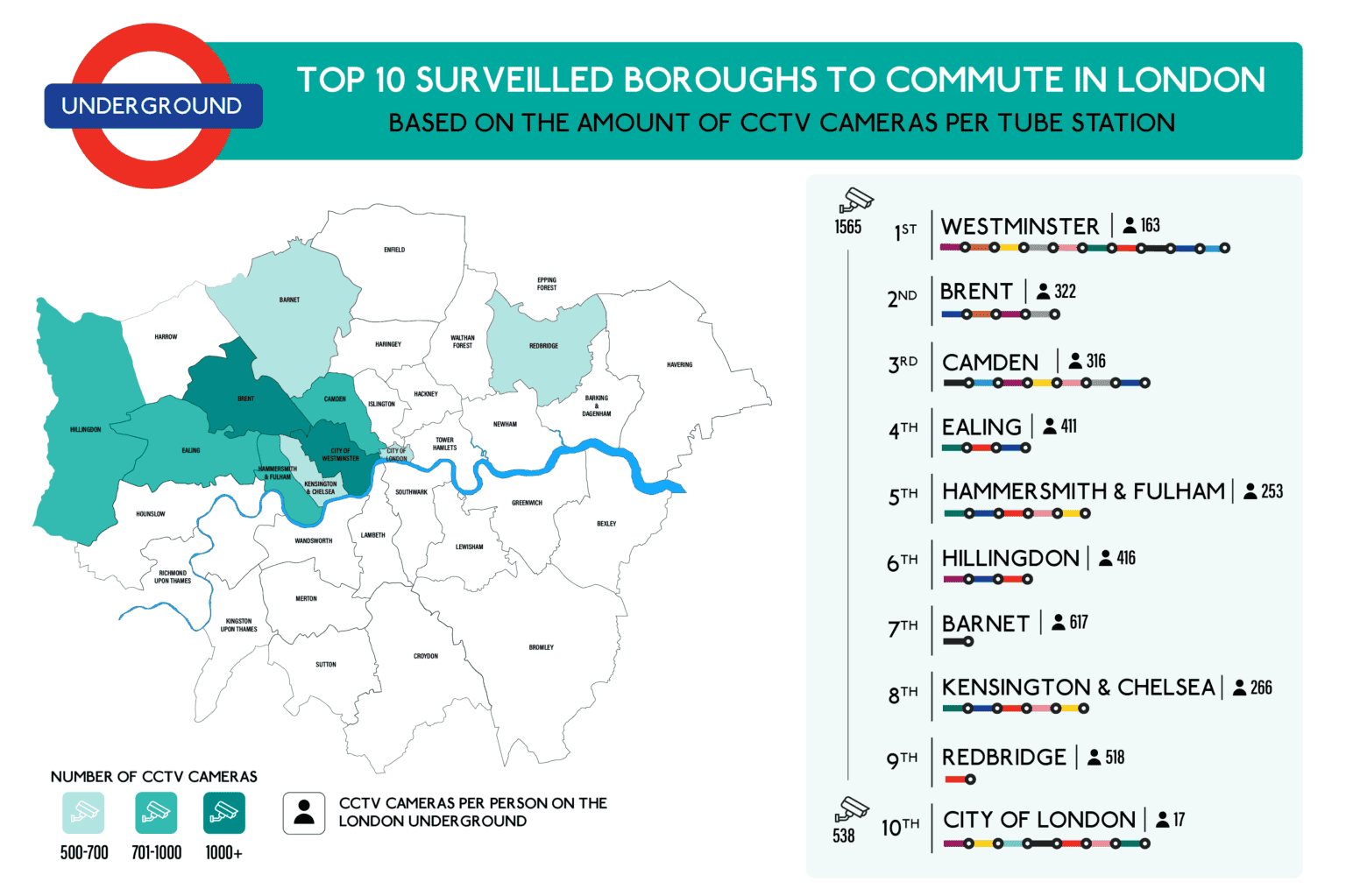
CCTV cameras per person on the London Underground
(Ratio = number of cameras : number of people)
| 1. City of London | 1 : 17 |
| 2. Westminster | 1 : 163 |
| 3. Hammersmith & Fulham | 1 : 253 |
| 4. Kensington & Chelsea | 1 : 266 |
| 5. Camden | 1 : 316 |
| 6. Brent | 1 : 322 |
| 7. Epping Forest | 1 : 383 |
| 8. Ealing | 1 : 411 |
| 9. Hillingdon | 1 : 416 |
| 10. Harrow | 1 : 465 |
Westminster, Brent and Camden may be the safest boroughs for travelling parents with the highest amount of surveillance, whilst some of the least protected school run routes can be found in Islington, Harrow and the City of London.
The data also showed that Newham has 196,000 more people than Kensington & Chelsea; however, this didn’t equate to more protection. It has an estimated 300 fewer cameras servicing the borough stations than the royal borough.
The 10 boroughs with the least CCTV cameras on the London Underground

Overall, commuters travelling through the west of London are recorded on camera far more than those travelling south of the river.

Related topics: How many CCTV cameras in London

Frequently Asked Questions – CCTV on the London Underground
Q. Which London borough has the most CCTV cameras on the Underground?
The City of London has the highest camera density, with roughly one camera for every 17 commuters passing through stations like Liverpool Street, Bank and Moorgate. Westminster has the highest total number of cameras, with an estimated 1,565 in operation.
Q. How many CCTV cameras cover the London Underground?
This research found 13,596 cameras in operation across London Underground stations.
Q. Which boroughs have the least CCTV coverage on the Underground?
Coverage is lower in outer boroughs and south of the river – commuters travelling through west London are recorded far more often than those travelling south.
Q. Why does camera density vary so much between boroughs?
Density tends to track major transport hubs, tourist attractions and dense urban environments – areas like Heathrow (Hillingdon) and the O2 Arena (Greenwich) rank highly, while more residential boroughs maintain lower but still significant coverage focused on schools and neighbourhoods.
Q. How many CCTV cameras are there in London overall?
London is one of the most surveilled cities in the world, with nearly one million CCTV cameras across public, business and private spaces – the Underground figures in this research are a small part of that total.
Q. Does high camera density mean a borough is safer?
Not necessarily on its own. High camera density supports public safety, crime prevention and efficient site management, particularly at busy locations, but coverage is only one factor in overall safety.


Written by
Wayne founded ACCL in 1997 and has led more than 28 years of project delivery, helping organisations design, install and modernise the network infrastructure behind reliable connectivity, office moves and refurbishments. His experience spans copper cabling, fibre backbones, data centre infrastructure, Wi-Fi, CCTV and access control. About ACCL