Improve your WI-FI speed
There are many factors that affect your Wi-Fi connection quality, as anyone who has ever tried to troubleshoot a Wi-Fi connection can attest. Seemingly trivial things, like turning a router around or putting it on the top shelf, can make the difference between a decent video conference and an awkward sequence of choppy half-dialogues.
Have you ever wondered what’s behind that – why networks that seem to use the same equipment have such drastically different performance? And why some networks seem to run fine from day one, while others require constant poking, tweaking and jabbing just to upload a large file on Dropbox?
Here are just a few of the important factors that we take into account when we work up the Wi-Fi installation design of a new office network.

- Wi-Fi Standard in Use
Several Wi-Fi generations remain in use, including Wi-Fi 4 (802.11n), Wi-Fi 5 (802.11ac), Wi-Fi 6/6E (802.11ax) and Wi-Fi 7 (802.11be). Older 802.11a/b/g equipment may still be encountered, but it should not be treated as the basis for a modern design.
These standards specify different frequency bands, different encoding technologies, RF parameters (such as receiver sensitivity), and maximum speeds. Furthermore, not all devices support all standards.
Consequently, the combination of client devices and Wi-Fi standards in use already places a theoretical limit on the maximum speed and range that you can achieve.
- Signal Power
802.11-family standards are all industry standards and are only concerned with networking. But manufacturers need to respect other regulations as well.
In particular, due to interference and health concerns, RF equipment used for personal and most commercial purposes is limited in terms of emission power.
Usable Wi-Fi range cannot be assigned reliably from the standard alone. Band, permitted power, antennas, client radios, building materials, interference and the required performance threshold all affect coverage, so design decisions should be based on survey measurements and agreed service targets.
- Equipment Quality and Build
Industrial and government standards place hard requirements on radio parameters of networking equipment but do not make specific requirements in terms of performance.
Consequently, the quality and performance of a Wi-Fi network also depend on a myriad of design choices that manufacturers make. Some of these are deliberate choices, as manufacturers try to cover the entire breadth of the price-performance spectrum. Others are pretty much accidental, and it’s just the best that a manufacturer can do.
- Antennae: Count and Quality
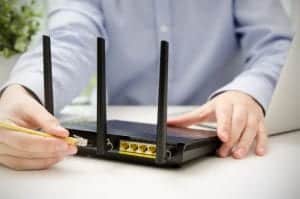
The antenna is a critical component of a device’s RF chain. Its build – size, material and connector quality – is therefore critical to the quality of your Wi-Fi signal. Antenna count can also influence your Wi-Fi connection quality in many ways.
Antenna quality tends to be a difficult thing to evaluate. For example, it’s important for antennae to be of particular sizes, not necessarily as big as possible. Consequently, antenna quality is something you tend to learn of rather than evaluate by looking at a device.
- Firmware Quality
The firmware running on a Wi-Fi router, Wi-Fi access points or Wi-Fi repeater is responsible for much of the RF operation of the device. It monitors signal quality and strength from all client devices, handles channel allocation, adjusts signal power and so on.
Bugs in firmware can, therefore, have a negative impact on your Wi-Fi signal and connection quality.
Some manufacturers issue updates for their devices’ firmware. Some of these updates fix connection quality issues, but it’s important to stay up-to-date with them regardless, as they often fix security issues, too.
- The RF Chain
The RF chain is that part of a device – smartphone, tablet, laptop, Wi-Fi access point, etc. – which encodes, transmits, receives and decodes radio signals. Its quality is critical to the quality and strength of wireless signals and to the quality of the network connection they carry.
Sometimes, the RF chain quality is not very symmetric. The network performance of a high-quality smartphone, for example, will be negatively impacted by a poor-quality Wi-Fi AP.
- Client Equipment
When it comes to client equipment, it’s not only the quality of the RF chain that determines your Wi-Fi networking experience. Other parameters, like the build quality and the quality of Wi-Fi drivers, can affect a particular device’s signal quality or speed.
It’s important to keep this in mind and to have a good overview of what client equipment you will deploy. Realistically assessing the capabilities of client equipment is an important part of determining the requirements of a Wi-Fi network.
Not sure what the requirements for your Wi-Fi network are? Schedule a FREE, no-obligation, on-site survey with ACCL. Our report will tell you all you need to know!
- Error Mitigation Capabilities
The quality of the RF signals going between a smartphone and a wireless access point can be degraded by a variety of factors, from RF interference to sheer distance.
Some devices support a number of error mitigation algorithms, such as LDPC (Low-Density Parity-Check). Activating these algorithms can improve signal quality and improve network performance under certain conditions.
- Environmental Factors
Hardware aside, practical experience shows that deploying the same equipment in different environments results in different performance characteristics.
Some environmental factors, like where you install a wireless access point, are firmly under your control. Others, such as RF noise and interference, aren’t fully under your control, so you need to take them into account when designing a Wi-Fi network.

- RF Noise and Interference
All Wi-Fi devices operate in several frequency bands in the 2.4 GHz and 5 GHz spectrum. The “all” part is very encompassing: that includes your Wi-Fi devices and your neighbour’s Wi-Fi devices – all of them operate in this spectrum, and sometimes they can interfere with each other. This has a negative impact on the quality of Wi-Fi signals.
Not all interference is due to other Wi-Fi devices. Other wireless protocols, such as Bluetooth and ZigBee, operate in the same frequency band as Wi-Fi. Sometimes, interference is entirely accidental: poorly screened USB 3.0 cables, for example, can generate significant RF noise.
The presence of RF interference decreases the performance of a Wi-Fi network, and its effects tend to decrease the closer you are to the Wi-Fi access point.
Consequently, wireless access points are placed so that they are sufficiently close to any client equipment while still far apart enough so as not to interfere with each other.
- Office Construction
The size of the rooms, the material of the walls and ceiling, and even the construction and relative height of the surrounding buildings influence the quality of the Wi-Fi signal in your office.
All these parameters influence both how signals from your equipment propagate and how much interference from the outside can get in.
RF signal propagation is one of the most complex domains of physics and electrical engineering. More often than not, we have to rely on both simulation and measurements in order to figure out where to place Wi-Fi access points for optimum performance.

- Access Point Location
Understanding Wi-Fi Access Points and Their Role in Boosting Signal
A Wi-Fi access point is a device that connects to your existing wired network to provide wireless coverage over an area. Think of it as an extension of your router, designed to enhance the range and strength of your Wi-Fi signal in parts of your home or office where connectivity might be weak.
How Access Points Boost Wi-Fi Signal
- Extended Coverage: By adding additional access points, you can significantly extend your Wi-Fi coverage. These devices create more entry points for your devices to connect, effectively eliminating dead zones.
- Improved Performance: Access points can handle more simultaneous connections compared to a single router. This is particularly beneficial in environments with many users or devices, as it helps manage bandwidth better and maintain a stable connection.
- Seamless Connectivity: With multiple access points, you can move around your space without worrying about dropping the connection. Your device will automatically switch to the strongest access point as you move.
Limitations of Stand-Alone Wi-Fi Access Points
Before delving into the myriad of factors influencing Wi-Fi performance, it’s essential to understand the inherent limitations of stand-alone Wi-Fi access points. Despite their performance advantages, these devices often encounter practical challenges. In many situations, installing the cabling necessary to connect an additional access point to the router is not feasible due to cost or aesthetic concerns. This limitation can be a significant hurdle in optimising your network setup.
Due to all these factors, the location of a wireless access point has a great deal of influence over Wi-Fi signal quality and strength.
Not only distance from client equipment but proximity to walls, structural elements such as reinforced concrete pillars, or large metallic objects like cabinets can be important factors to consider when deploying Wi-Fi access points.
- Device Installation
Where exactly an access point is placed is not the only factor that influences performance. Many other factors related to the position of an access point have important consequences.
For example, an antenna does not radiate RF signals uniformly. There is a narrow region, right on top of the antenna, where the signal strength is very low. Antenna orientation, both in relation to client equipment and to the surrounding environment (walls, structural elements), can influence Wi-Fi signal quality.
Other important factors related to device installation include ventilation, RF screening (deliberate or not) and height.
Considerations Before Installation
While access points are excellent for boosting signal, there are a few considerations to keep in mind:
- Wiring Requirements: A key aspect of installing an access point is the necessity of a physical connection to your main router via Ethernet cables. This can sometimes be a challenge where aesthetics or structural feasibility is concerned.
- Cost: Setting up multiple access points may involve higher upfront costs, especially when cabling through walls and ceilings is required.
For those seeking to optimise their Wi-Fi experience, incorporating access points is a highly effective strategy. With the right setup, you can enjoy a fast, reliable connection throughout your entire space.
What can interfere with Wi-Fi signal and network factors
Some of the factors that influence wireless performance are not related to a specific device but to the network as a whole. Most of these factors are under your control, and taking them into account when devising a Wi-Fi network is critical to its performance and reliability.
- Number of Connected Devices
So, what can interfere with Wi-Fi? Have you noticed how, when you are in a very crowded room, it’s sometimes hard to hear what another person is hearing? Even though you can definitely hear the noise, it’s hard to isolate one specific voice.
A somewhat similar phenomenon can happen in RF devices, too. Only a finite number of client devices can be connected to an access point at a given time.
It looks like this problem is easy to solve: if there are 400 devices in an office, and an access point can support up to 100 devices, 4 access points should be enough, right?
Unfortunately, Wi-Fi devices tend to be very mobile today. Sometimes – during an all-hands meeting, for example – 200 of those devices can be in a single room.
Consequently, it’s not only the device count that matters, it’s also the usage patterns of those devices. Crowded areas, like cafeterias or large conference rooms and auditoriums, may need to be over-budgeted.
- Uplink Speed and Load
Wi-Fi access points still have to connect to the rest of your network and then to the Internet. Traffic between different departments, for example, will go through more devices than just a Wi-Fi access point. And, of course, Internet traffic goes through your ISP.
The performance of your Wi-Fi connection depends on how fast and how busy the network on the “other side” of the wireless access point is.
This is not something that you can mitigate on the wireless side, but it is something that you need to take into account. Wi-Fi traffic tends to be very diverse: smartphones can download hundreds of megabytes of firmware upgrades, and the age of BYOD means that company networks need to accommodate some personal traffic in the background as well.

- Equipment Configuration
Just like a car can be tweaked for better performance, networking equipment can be configured to improve the speed or reliability of its connections.
Sometimes, this configuration is strictly about optimisation, such as enabling the use of an error mitigation algorithm. But sometimes, it’s a matter of right and wrong.
For example, the exact frequency bands that a device can use and the maximum signal strength vary from one country to another (confusingly enough, some parameters differ even between the UK and Australia, for instance).
Some devices are pre-programmed for a given market, but others need to be configured for operation in a particular region. Operating under the wrong parameters can lead to poor signal quality and sub-optimal performance.
- Network Configuration
The configuration of your network will not affect the quality and strength of the Wi-Fi signal, but it will affect the performance you can get out of it.
The correct (or incorrect) configuration of your core network can affect the bandwidth and latency you get out of your wireless access points, sometimes in unpredictable ways.
Furthermore, Wi-Fi networks have a different structure and very different behaviour from wired networks. They aren’t designed in the same way, and integrating the wired and wireless sections of your network is an important aspect of network design.
If you want to make sure that you have a fast and reliable Wi-Fi network and see what interferes with your Wi-Fi signal, we’re just a phone call or an email away. We’ve been installing various types of networks in London for more than 20 years. Get in touch with us for your complimentary, no-obligation survey.
Related topics: How to set up Wi-Fi in the office Point-to-point Wi-Fi



Written by
Wayne founded ACCL in 1997 and has led more than 28 years of project delivery, helping organisations design, install and modernise the network infrastructure behind reliable connectivity, office moves and refurbishments. His experience spans copper cabling, fibre backbones, data centre infrastructure, Wi-Fi, CCTV and access control. About ACCL