Plan, install and maintain reliable cabling, wireless and security infrastructure with ACCL. We support organisations across London and the South East with practical, end-to-end solutions designed to reduce downtime, improve connectivity and support future growth.
ACCL designs infrastructure around the demands of your environment. From offices and schools to healthcare, public-sector and industrial sites, we deliver dependable cabling and network solutions that support performance, security and day-to-day operations.
Commercial fibre optic cable repair in London starts with finding the real source of the failure. A dark link or unstable service may be caused by the installed cable, a connector, patch lead, splice, optical transceiver, switch, power supply or configuration. ACCL approaches the incident methodically so that the evidence determines whether the correct action is cleaning, retermination, fusion splicing, a replacement section or a new route.
We support commercial premises, offices, campuses, server rooms and operational sites across London, Kent, Surrey and the South East. Requests can be planned around maintenance windows or assessed as urgent work, subject to engineer availability, safe access and the fault scope. The objective is a maintainable repair with appropriate testing and records, not an unsupported promise that every failure can be restored immediately.
Commercial Fibre Fault Finding and Repair
Fibre faults can stop an entire backbone or appear as increased loss, intermittent errors or reduced stability. Before invasive work begins, ACCL reviews what has changed, which services are affected and whether the symptoms point to the passive fibre plant or active equipment. Existing test results, route drawings, cabinet labels and photographs can shorten diagnosis and help identify the correct fibre type, core count and termination arrangement.
The repair scope may involve connector inspection and cleaning, replacing a damaged pigtail, reterminating a fibre, fusion-splicing a cut cable, installing a protected replacement section or replacing the full route. The selected method depends on access, available slack, cable construction, environmental protection and whether the completed link can be tested against the agreed requirement.
Fibre Faults ACCL Can Investigate
Loss of signal and intermittent links
A complete failure, fluctuating optical levels or an unstable service may relate to excessive loss, contamination, a poor connection, a failing splice or damage along the route. Active equipment remains part of the wider diagnostic picture.
Cut, crushed or over-bent fibre
Building works, cabinet changes, mechanical impact, rodents, water ingress or an unsuitable bend can damage cable or fibres. Accessible local damage may be repairable; extensive or unprotected damage can make replacement more appropriate.
Connector, splice and patching faults
Dirty or damaged connector end faces, incorrect patching, mismatched components, strained pigtails and poor historic joints can all contribute to loss. Inspection comes before assuming the permanent cable is at fault.
How Fibre Fault Finding Works
The first task is to establish the fault boundary. Engineers review the affected services and available documentation, inspect cabinets and accessible route sections, and check patching and optical components. Optical-power measurements can help compare received levels, while a visual fault locator may reveal some accessible breaks or severe bends. An optical time-domain reflectometer can provide a graphical view of loss events and distance along suitable links.
OTDR testing is valuable, but it is not automatically used on every callout. Link length, connector arrangement, fibre type, access and the question being answered determine the test method. The FOA guidance on fibre optic restoration similarly emphasises documentation, systematic troubleshooting and distinguishing cable-plant problems from communications electronics.
Our Fibre Repair Process
A controlled process reduces unnecessary disruption and creates a clearer repair record. The sequence is adapted to the site, but three stages normally shape the work.
Triage and route information
Confirm symptoms, affected services, urgency, fibre type if known, cabinets, route, access limitations and recent work near the cable.
Inspection, testing and fault location
Separate passive and active possibilities, inspect accessible components and apply the optical test methods appropriate to the suspected fault.
Splice, replace and retest
Complete the agreed repair, protect and identify the work, then retest the link and provide the required handover information.
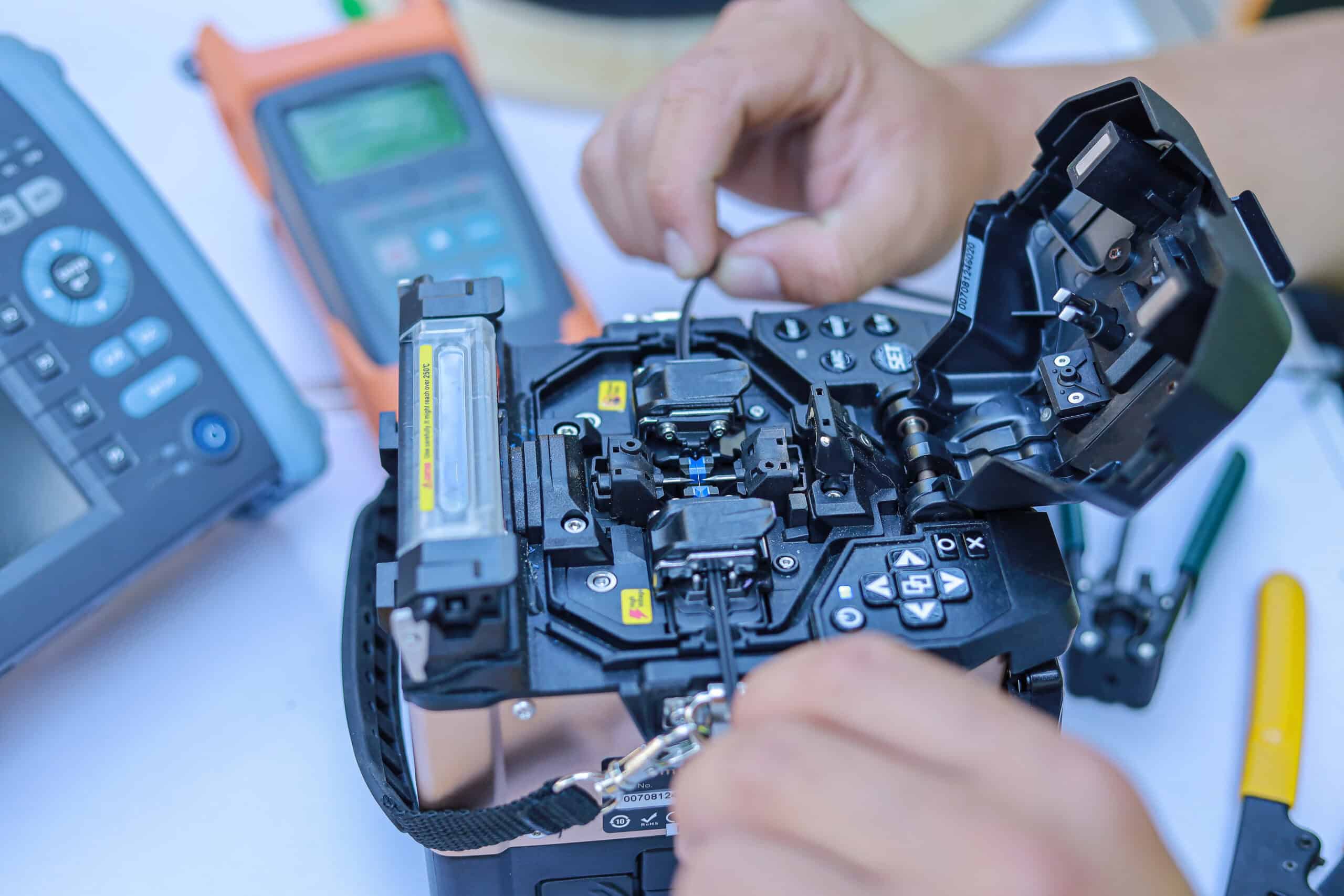
ACCL fibre termination work. The repair method is selected after diagnosis.
Fibre Types, Connectors and Repair Capability
Commercial estates can contain several generations of fibre. ACCL can assess multimode OM1, OM2, OM3, OM4 and OM5 and single-mode OS1 and OS2 where these are present, but the installed specification must be confirmed rather than assumed. Fibre type, wavelength, core count, polarity and the optics at each end all affect compatibility and testing.
Common interfaces include LC, SC and ST, with different polish types and legacy arrangements also encountered. A connector cannot be replaced simply because it fits mechanically: fibre type, end-face geometry, adapter, pigtail and active equipment must align with the system. For wider installation, extension or upgrade requirements, see ACCL’s fibre optic installation service.
Fusion-splicing repair
Fusion splicing aligns and joins prepared glass fibres using specialist equipment. It can provide a low-loss permanent joint when suitable slack, access and enclosure protection are available. The splice must be housed and managed correctly; an exposed joint is not a complete commercial repair.
Retermination and connector work
Where the cable remains serviceable, a damaged pigtail or termination may be renewed. Inspection and cleaning are important because contamination can create loss without visible cable damage. ACCL can also coordinate related fibre optic splicing and termination work.
Emergency Callouts and Planned Remediation
An urgent fibre failure needs concise information. The site address, affected service, number of users or systems, cabinet and port identifiers, fibre type, route information, photographs and access restrictions all help define the first attendance. If construction or maintenance work preceded the failure, record where and when it occurred.
Urgent requests are assessed subject to engineer availability, travel, safe access and the likely repair requirement. Attendance does not guarantee immediate restoration: the route may need permits, specialist access, replacement cable, additional enclosures or coordination with an internet service provider or other network owner. Planned remediation can instead be sequenced around a maintenance window, resilience path or agreed temporary arrangement.
When Fibre Can Be Repaired or Must Be Replaced
A local fusion-spliced repair can be appropriate when the fault is accessible, the cable has sufficient serviceable length and the joint can be protected in a suitable enclosure. Retermination may solve damage limited to a connector or pigtail. A replacement section can be preferable where several nearby fibres are affected or the cable jacket has been compromised.
Full replacement becomes more likely when damage is widespread, slack is inadequate, the route is unsafe or inaccessible, the installed fibre is unsuitable for the requirement, or repeated historic repairs would create an unmaintainable result. The decision also considers downtime, future access and whether the final link can meet its required loss budget.
Repair decisions should follow evidence
A fibre link that has stopped working is not proof that the permanent cable is broken. Patching, optics, power and configuration should remain within the diagnostic boundary until testing shows otherwise.
Optical-Loss and OTDR Testing
Post-repair testing should answer whether the repaired link is continuous and performs within the agreed requirement. Depending on scope, this may include connector inspection, continuity, optical-loss measurement and OTDR traces. Bidirectional or wavelength-specific evidence may be appropriate for some systems, while a simple local repair can require a different handover.
Results are meaningful only when fibre type, reference method, wavelengths, launch arrangements and acceptance limits are understood. Testing is therefore specified for the job rather than described as a universal certification package. ACCL can coordinate dedicated fibre optic testing and certification where fuller route evidence is required.
What Affects Fibre Repair Cost?
Cost depends on urgency, location, working hours, access equipment, route complexity, diagnosis time, fibre type, core count and the extent of the damaged section. Materials can include pigtails, connectors, splice protectors, trays, closures and replacement cable. Testing and documentation requirements also affect the scope.
Photographs, cabinet labels, original test reports and accurate route information support a more useful initial assessment. Where the fault may involve copper links or outlets rather than fibre, ACCL’s data cabling repair service provides the relevant route.
Why Choose ACCL for Fibre Optic Repair?
ACCL combines fibre installation, splicing, testing and commercial-site delivery within one service team. That breadth matters when a fault turns into a replacement section, an enclosure change or a wider route issue. The existing TUI and Observer Building project material below demonstrates broader fibre and infrastructure capability; it is not presented as evidence that those projects were emergency repairs.
Work is planned around the live environment, access requirements and the agreed test outcome. Where related backbone, cabinet or critical-room work is involved, ACCL can coordinate with its data centre solutions capability, including data centre fibre cabling repairs. Any insurance, accreditation, membership or warranty statement used for procurement will be confirmed against current documentation.
Request a Fibre Repair Callout
Share the affected location, symptoms, urgency, fibre details, route information and access constraints. ACCL can review the incident and confirm the appropriate next step and likely callout scope.
I have been dealing with Wayne at ACCL for some time now, as I was tasked by my employer to refurbish our server cabinets across 30 offices in London. I can’t begin to express how good Wayne and his guys are. They have replaced and refurbished a large number of our server cabinets so far, with no issues, all in a very timely manner.
They have done a highly professional job, have always kept in contact, and have given us advice/suggestions on what was needed when we weren’t too sure. I would highly recommend using ACCL for any IT/Cabling work.
Chestertons / Werner May
As the client I can only say thanks and its an amazing piece of work by all involved. Believe me that the work to coordinate this work around other issues was challenging but Wayne and ACCL were great.
TUI / Scott Ronan
Planning tools: For planned remedial work, review the expected end-to-end loss and remaining margin with the fibre optic loss budget calculator.
Plan Your Fibre Optic Repair
Discuss the fault, route, splicing and testing scope with ACCL. A survey can confirm the cause and the repair approach before quotation.
ACCL can investigate complete signal loss, excessive optical loss, intermittent links, cut or crushed cable, damaged connectors, poor terminations, suspect splices and patching issues within commercial fibre infrastructure.
Q. How can you tell whether a link failure is caused by the fibre cable?
The investigation separates passive cable-plant issues from patch leads, optical transceivers, switches, power and configuration. Visual inspection and appropriate optical tests then narrow the likely fault location.
Q. Can a cut fibre optic cable be repaired?
Often, provided the damaged section is accessible and there is suitable cable length, protection and space for a maintainable splice. Some routes require a replacement section or complete cable instead.
Q. When must a damaged fibre cable be replaced?
Replacement may be required when damage is extensive, several points are affected, the route is unsuitable, there is insufficient slack or a protected and testable repair cannot be achieved.
Q. Can ACCL repair both single-mode and multimode fibre?
ACCL can assess common commercial single-mode and multimode installations, including OS1, OS2 and OM-series fibre. Existing fibre type, core count, connectors and active equipment must be confirmed.
Q. What is fusion splicing and when is it used for repair?
Fusion splicing aligns and joins prepared glass fibres using specialist equipment. It can provide a low-loss permanent joint when the cable, access, enclosure and repair design are suitable.
Q. Can damaged fibre connectors and terminations be replaced?
Yes, damaged connectors, pigtails and terminations can often be renewed. The correct connector, polish type, fibre type and enclosure arrangement must be matched to the existing system.
Q. How is a fibre fault located?
Engineers review symptoms and route records, inspect accessible components and use suitable optical-power, visual fault-location or OTDR methods according to the link and suspected problem.
Q. Is OTDR testing used on every fibre repair?
No. OTDR testing is valuable for locating and characterising events along many fibre routes, but it is not automatically the right or only test for every fault or repair.
Q. How is a repaired fibre link tested?
Testing is agreed for the link and repair scope. It may include connector inspection, continuity, optical-loss measurement and OTDR traces, followed by clear identification and repair records.
Q. Can ACCL attend an urgent commercial fibre fault?
ACCL can assess urgent commercial requests subject to engineer availability, location, site access and fault scope. Attendance and likely next steps are confirmed for the individual incident.
Q. What information should be provided before a fibre repair callout?
Provide the site address, affected services, fibre type and core count if known, cabinet and port identifiers, symptoms, route information, photographs, access constraints and urgency.
Q. How long does fibre repair take?
Duration depends on diagnosis, access, damage extent, cable slack, core count, enclosure requirements, replacement length, testing and whether active equipment also needs investigation.
Q. What affects fibre repair cost and how is a callout requested?
Cost depends on urgency, location, access, working hours, diagnosis, splicing or replacement materials, core count, testing and records. Use the ACCL contact page or call 0333 900 0101.
Active Communication Company Ltd trades as ACCL, ACCL Data Cabling London and ACCL Data Cabling Kent · Commercial data cabling and network infrastructure specialists