Structured cabling cost can vary significantly depending on the building, cable standard, number of data points, CPR fire rating, testing requirements and whether the project is a new fit-out or retrofit.
Quick Answer: How Much Does Structured Cabling Cost in the UK?
On straightforward commercial projects, a professionally installed Cat6 data point in the UK will often sit between £75 and £120, inclusive of materials, labour, certified testing, and documentation. Complex access, out-of-hours work, unusual containment, long routes, small projects or higher-specification requirements can move costs outside this range.
Cat6A installation sits towards the upper end of that range, as the shielded cable costs around 30% more. Retrofitting an occupied office can add up to 40% to the cost of a clean, new-build pre-wire.
There is no universal price for structured cabling. Costs depend on building size, cable standard, number of data points, project type (new fit-out vs retrofit), and cable CPR fire rating. This guide explains each cost driver behind a UK structured cabling quote, so you can assess quotes confidently. For full service details, see our structured data cabling installation page.
Need an early project budget?
Use our Structured Cabling Cost Calculator to build an indicative estimate for Cat6, Cat6A, fibre, Wi-Fi, CCTV and access control before arranging a site survey.
Structured Cabling Cost at a Glance: The Seven Drivers
| Cost driver | What it affects | Typical impact |
|---|---|---|
| Number of data points | The total number of outlets or drops required across the site. | £75–£120 per drop Typical Cat6 range |
| Cable standard | Cat6A uses heavier shielding and supports 10 Gbps over the full 100m channel. | +15–25% On total project cost |
| New build vs retrofit | Occupied offices, solid ceilings and fire-rated walls take longer to work around. | Up to +40% For retrofit projects |
| CPR fire rating | The correct cable rating depends on the building, route and project specification. | A few hundred pounds Typical Cca premium on a 50-drop job |
| Testing and certification | Professional quotes should include per-link Fluke or equivalent certification testing. | Usually included In reputable quotes |
| Documentation and warranty | As-built records, test results and warranty terms support future changes and maintenance. | Included with ACCL On qualifying installations |
| Labour | Routing, terminating, labelling and testing cable is the most time-intensive part. | ≈70% Of total installation cost |

Cat6 Cabling Cost Per Drop in the UK
A professionally installed Cat6 data point in the UK typically costs between £75 and £120, all in. That figure covers materials, labour, certified testing, and as-built documentation.
If you are moving to Cat6A installation, which is commonly recommended for new commercial projects where future capacity is a priority, the materials alone cost around 30% more due to the heavier shielding, and your per-drop cost will sit towards the upper end of that range.
That spread is not random. It reflects real differences in what is being installed, how it is being tested, and how thoroughly the work is being documented.
Why Labour Is Around 70% of a Data Cabling Quote
This surprises a lot of people. The copper itself is not the expensive part. Labour typically accounts for around 70% of the total installation cost.
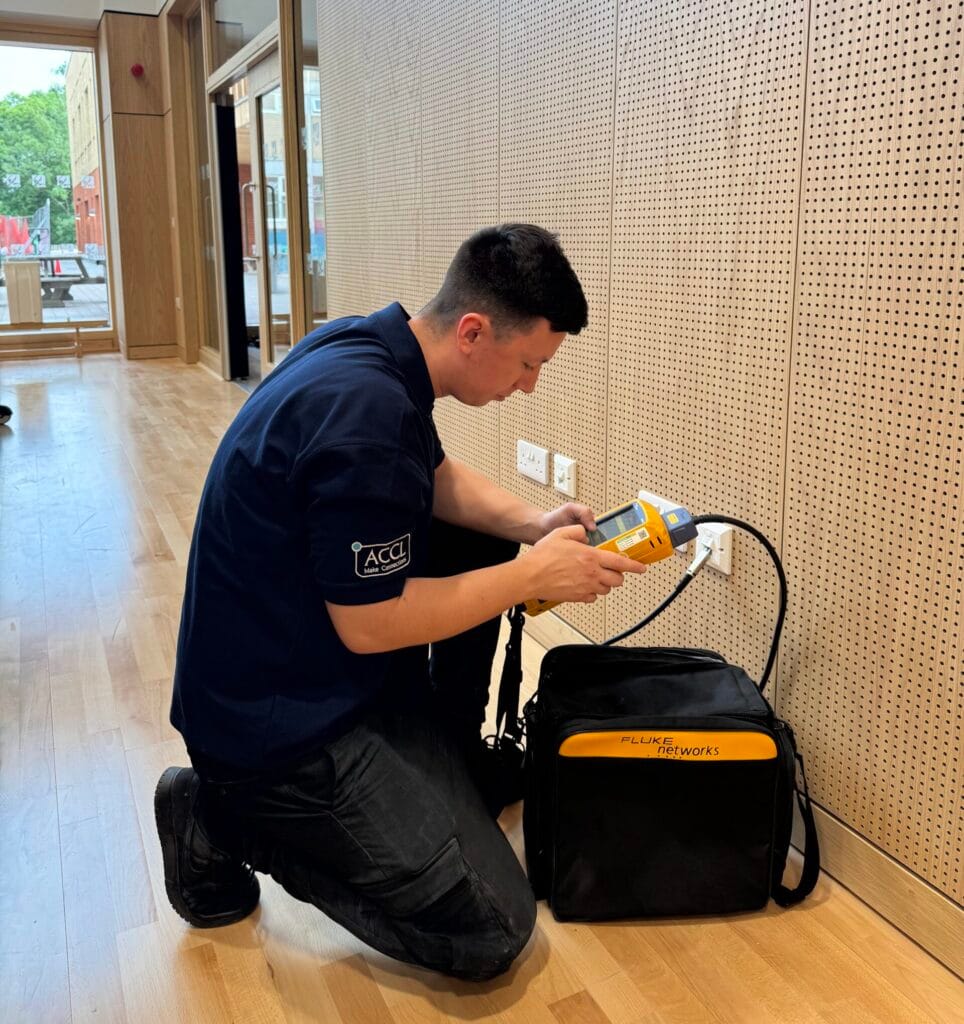
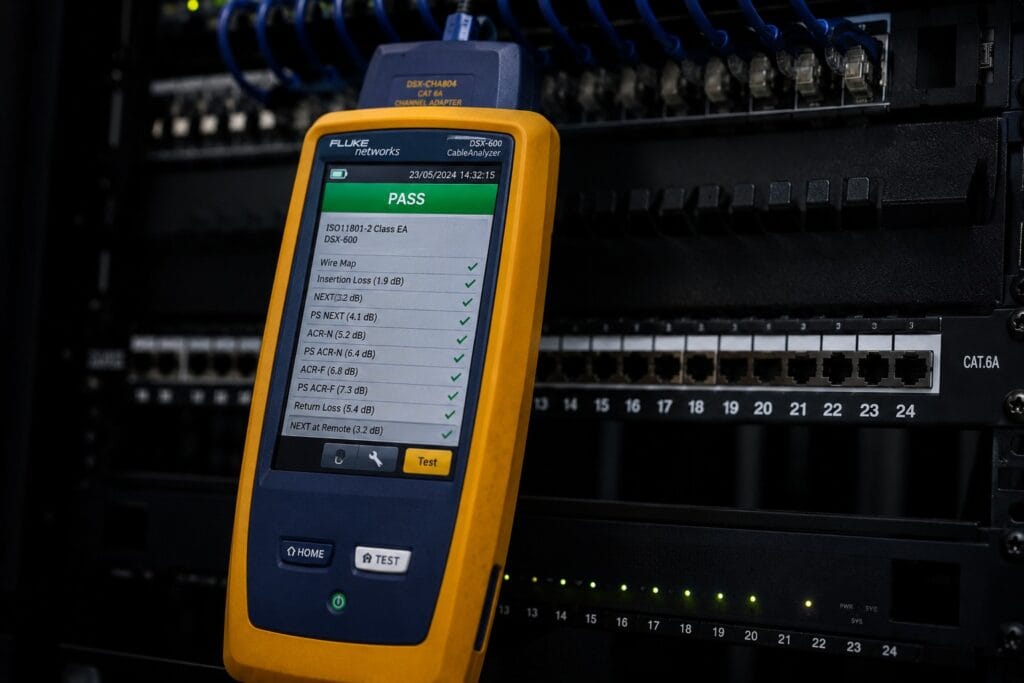
You are paying for a skilled engineer to navigate your building, route cable correctly, terminate every connection cleanly, and test every single drop to industry standards. In the UK, that means compliance with BS EN 50173 and ISO/IEC 11801. A reputable installer will test every cable link individually using calibrated Fluke or equivalent equipment before handover and provide full as-built documentation.
That certification report matters. It is the difference between knowing your network will hold up under real load and simply hoping it will.
New Build vs Retrofit: The Hidden Cost Driver
If you are fitting out a new office with open walls and an accessible ceiling void, structured cabling installation is relatively straightforward. But if you are retrofitting an existing occupied office, navigating solid ceilings, furniture, fire-rated walls, and a team still trying to work around you, costs can be up to 40% higher than a clean pre-wire scenario.
Engineers are not just pulling cables; they are carefully threading them through a building that was not designed for easy access. ACCL schedules office cabling installation to minimise disruption, including arranging evening and weekend work where needed, with a dedicated project manager as your main point of contact throughout.
Cat6 or Cat6A: Which Is Worth the Extra Cost?
For most offices today, Cat6 does the job. But Cat6A extends 10 Gbps capability to the full 100-metre channel length and provides better shielding against crosstalk, making it the preferred choice for new installations where future-proofing is a priority.
If you are signing a five-year lease and plan to run Wi-Fi 7 access points or Power over Ethernet devices across the building, in many cases the extra cost of Cat6A installation during the initial project will be lower than the cost and disruption of replacing the cabling later. For wireless infrastructure planning, see our Wi-Fi installation and Wi-Fi site survey services.
| Cable type | Typical cost per point (UK, fully installed) |
|---|---|
| Cat6 | £75–£120, inclusive of materials, labour, certified testing and documentation. |
| Cat6A | Towards the upper end of the £75–£120 range — materials cost around 30% more than Cat6. |
For the full breakdown of every cable category — including Cat5e, Cat6e, Cat7 and Cat8 — see our complete Cat5e vs Cat6 vs Cat6A vs Cat7 vs Cat8 comparison guide.
The Seven Euroclasses: From Best to Worst
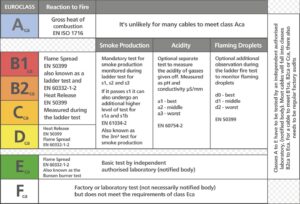
There are seven CPR Euroclasses ranging from Aca (best) to Fca (worst). In practice, for commercial structured cabling in the UK, you will encounter three or four of these:
Eca is one of the lowest classes you are likely to encounter in a commercial setting. It only needs to pass a basic vertical flame test, with no testing for acid gases or smoke. It is the cheapest option, but it does not meet the recommended standard for hidden installations, such as anything going behind walls, above ceilings, or under floors in UK buildings.
Dca sits a step above and involves more rigorous testing, including a 20.5 kW flame test, and must also be assessed for total heat release, total smoke production, flame droplets, and peak smoke production rate. It is commonly specified for standard commercial and residential premises.
Cca-rated cable is the practical standard for most UK commercial cabling projects. It offers better performance in flame spread, smoke production, and heat release compared to lower classifications. Cca-rated cable is commonly expected on many commercial projects, particularly where specified by the consultant, landlord, insurer or client. If a specification calls for Cca, Eca will not be accepted, even if it technically meets minimum CPR requirements.
B2ca is reserved for high-risk environments such as hospital wards, children’s nurseries, and airports, where the cable’s contribution to fire must be very low.
The Sub-Classifications That Actually Matter
Beyond the headline class, there are additional criteria that appear as suffixes on the cable label. A cable specified as Cca-s1b,d2,a2 is telling you something specific:
- Smoke production (s1a, s1b, s2, s3): how much smoke the cable produces when burning
- Flaming droplets (d0, d1, d2): whether burning material will drip and spread fire
- Acidity (a1, a2, a3): how corrosive the gases produced will be
That combination matters in buildings where occupants need time to evacuate safely. It is not decorative labelling.
What CPR Rating Does UK Commercial Cabling Actually Require?
The UK wiring regulations BS 7671 refer to BS 6701:2016+A1:2017, which is commonly used as the benchmark for UK commercial cabling and recommends Cca-s1b,d2,a2 for permanently installed telecoms cables in hidden locations.
This applies to new-build projects, refurbishments, and extensions to existing buildings. The correct CPR rating for any specific project should be confirmed during survey and design, based on building type, cable route, specification and client requirements.
Crucially, because the cabling infrastructure is governed by BS 7671, the decision on which cable to use must be made during the design phase and approved by the client, not quietly decided by the installer on the day the van arrives. The CPR rating needs to be agreed, specified, and documented upfront.
What Does the CPR Rating Difference Actually Cost?
The premium is real but not dramatic. To put a figure on it: on a CCTV installation project with 30 cameras and an average cable run of 30 metres, upgrading from standard cable to CPR-compliant Cca-rated cable typically adds less than £5 per camera to the material cost. Scale that to a 50-drop office cabling job and the material premium for Cca over Eca is unlikely to move your total invoice by more than a few hundred pounds.
Costs climb more noticeably when you move from Cca up to B2ca. Those higher classes involve more complex cable construction, and at Cca and above the factories manufacturing the cable are regularly audited and retested by an approved third party. As a general principle, specify only what your installation genuinely requires. If the job calls for Cca, specifying B1ca would work, but is unlikely to be justifiable on cost grounds.
The Biggest Financial Risk: Getting the CPR Rating Wrong
The real financial risk with CPR is not the cable itself. It is getting it wrong and having to redo the installation. If Eca cable is installed where the project specification, consultant, insurer, landlord or building control requirements call for Cca, the cost of correction can be significant. That is a full retrofit cost on a job you have already paid for. This is exactly why the fire rating conversation has to happen at the survey stage, not at handover.
What a Transparent UK Structured Cabling Quote Should Include
When you receive a quote for a structured cabling project, it should clearly set out:
- The cable standard being installed, such as Cat6, Cat6A, or fibre
- The CPR Euroclass and sub-classifications of that cable, for example Cca-s1b,d2,a2
- The number of data points and their locations
- Testing methodology and certification, such as per-link Fluke or equivalent certification testing to BS EN 50173 / ISO/IEC 11801
- As-built documentation
- Warranty terms, including whether it is a manufacturer-backed system warranty
If a contractor cannot tell you the CPR rating of the cable they plan to install, or will not put it in writing, that is a red flag. A properly installed structured cabling system is a long-term asset for your business. The fire rating of the cable running behind your walls is part of the building’s safety fabric. Both deserve the same level of attention.
You can also read our case studies to see how ACCL has approached structured cabling projects across a range of commercial environments, from office fit-outs to large-scale multi-site installations.

See it in practice: our seven-floor London network infrastructure upgrade for The Writer was delivered and certified to exactly these standards. See also our structured data cabling hub.
FAQ – Structured Cabling Cost UK
How much does structured cabling cost per data point in the UK?
A professionally installed Cat6 data point in the UK typically costs between £75 and £120, inclusive of materials, labour, certified testing, and as-built documentation. Cat6A installation sits towards the upper end of that range. The exact figure depends on the number of drops, cable standard, CPR fire rating specified, and whether the site is a new build or a retrofit.
What is included in the price per data point?
A complete installation includes solid copper cable, containment, termination at both ends, Fluke or equivalent certification testing to BS EN 50173 / ISO/IEC 11801, a full test report, as-built documentation, and a 25-year manufacturer-backed warranty on qualifying installations.
What CPR fire rating is required for cables in UK commercial buildings?
For data cables installed behind walls, above ceilings, or below floors in UK commercial buildings, BS 6701:2016+A1:2017 recommends a minimum of Cca-s1b,d2,a2. Cca-rated cable is commonly expected on many commercial projects, particularly where it is specified by the consultant, landlord, insurer or client. Higher-risk environments such as hospital wards, nurseries, and airports typically require a minimum of B2ca. The correct rating should always be confirmed during the survey and design stage.
Is Cat6A installation worth the extra cost over Cat6?
For most offices today, Cat6 is sufficient. Cat6A is worth specifying when you need 10 Gbps over the full 100-metre channel, when you plan to deploy Wi-Fi 7 access points or Power over Ethernet devices at scale, or when you expect the cabling to outlast a five-year lease. In many cases, the extra cost of Cat6A during the initial installation is lower than the cost and disruption of re-cabling later.
Why does retrofitting cost more than new-build cabling?
Retrofitting an occupied office can add up to 40% to the installation cost. Engineers have to work around solid ceilings, fire-rated walls, furniture, and people still trying to do their jobs. Evening and weekend working, dust control, and careful cable routing all add hours that simply do not exist on an open pre-wire site.
What should a transparent data cabling quote include?
A transparent UK data cabling quote should specify the cable standard, the CPR Euroclass and sub-classifications, the number of data points, the testing methodology and certification, as-built documentation, and warranty terms covering both materials and workmanship. If any of those items are missing, ask the installer to add them in writing before you sign anything.
How long should a structured cabling system last?
A properly installed structured cabling system, certified to BS EN 50173 / ISO/IEC 11801 and supported by a manufacturer-backed warranty, should comfortably last 10 years and often longer. ACCL backs qualifying installations with a 25-year manufacturer warranty, supported by our accredited partnerships with Leviton, Excel and Molex.


Written by
Wayne founded ACCL in 1997 and has led more than 28 years of project delivery, helping organisations design, install and modernise the network infrastructure behind reliable connectivity, office moves and refurbishments. His experience spans copper cabling, fibre backbones, data centre infrastructure, Wi-Fi, CCTV and access control. About ACCL