
MF Global, Canary Wharf: high-density trading-floor network infrastructure
22,000 Leviton Cat6 outlets and a diversely routed fibre backbone, delivered for one of ACCL’s largest-ever structured cabling projects.
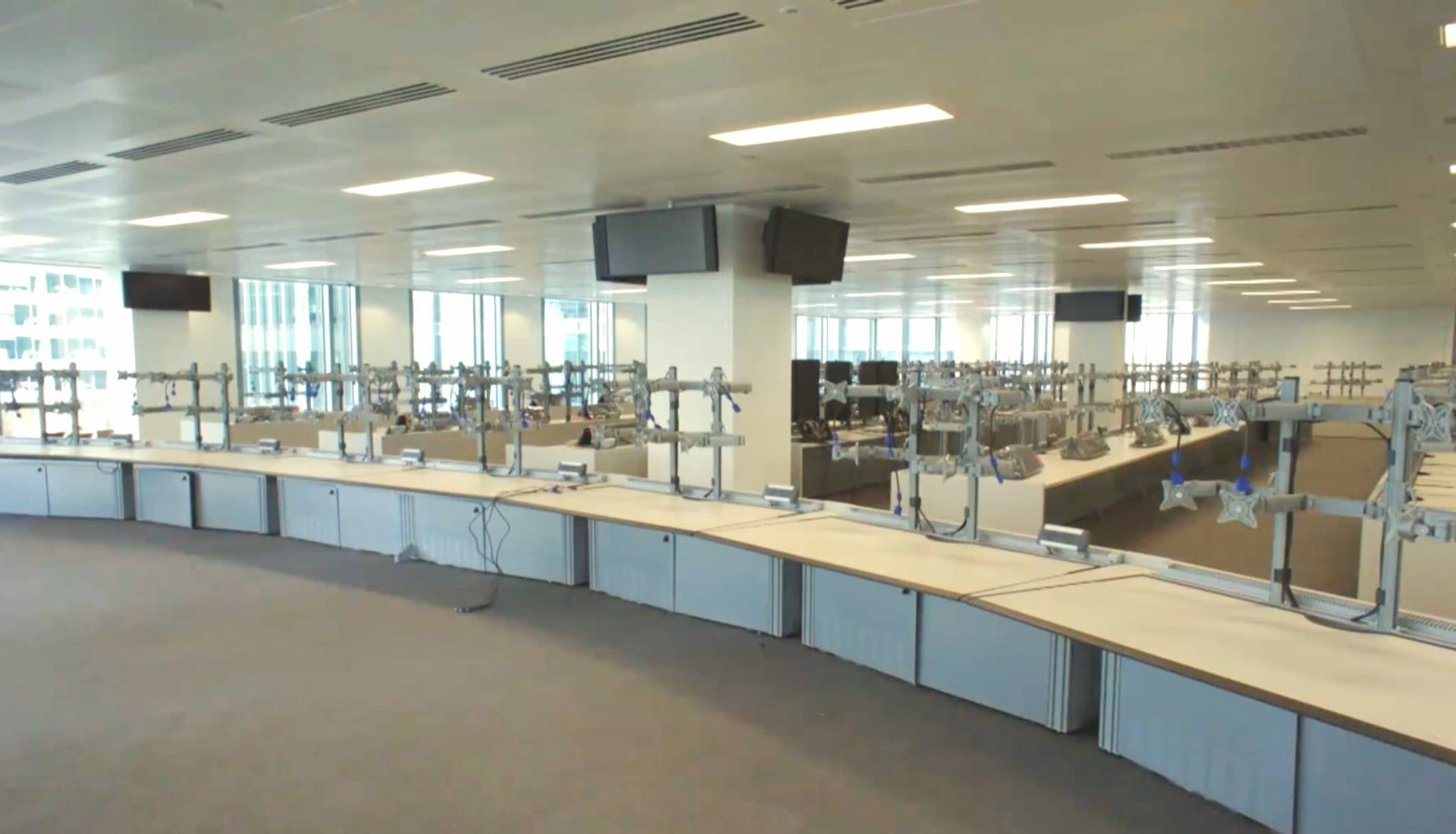
In 2002, global financial derivatives broker MF Global (formerly Man Financial) refurbished its trading operations at 5 Churchill Place, Canary Wharf, and appointed ACCL to design and deliver the structured cabling and fibre-optic infrastructure across four floors. The scope grew from around 18,000 to 22,000 network ports while the installation programme shrank to under three months, making this the largest structured cabling project ACCL had undertaken at the time.
The result
Despite a substantial increase in scope and an exceptionally compressed programme, ACCL delivered the MF Global infrastructure on time, to plan and within budget. The completed installation provided MF Global with:
- 22,000 Leviton Cat6 data outlets installed
- Approximately 1,036km (644 miles) of Cat6 copper cabling
- Approximately 2,000m of diversely routed 48-core fibre
- Four dedicated, coordinated communications rooms
- 20 APC data cabinets and 15 Krone frames
- 100% Fluke-tested copper and fibre infrastructure
- Approximately 1,000 ceiling points for future wireless
- Delivered on time, to plan and within budget
Services delivered
Overview
In 2002, global financial derivatives broker MF Global, formerly known as Man Financial, undertook the redesign and refurbishment of its operations at 5 Churchill Place, Canary Wharf, London. The project gave MF Global an opportunity to establish a new corporate standard for its network infrastructure across four floors of high-density financial trading operations, and ACCL was appointed to design and deliver the structured cabling and fibre-optic infrastructure.
The scale was exceptional. The completed installation comprised 22,000 Leviton Category 6 data outlets, approximately 644 miles (1,036km) of copper cabling, approximately 2,000 metres of diversely routed 48-core multimode fibre, four communications rooms, 20 APC data cabinets and 15 Krone frames. At the time, MF Global represented the largest structured cabling project undertaken by ACCL and became an important milestone in the company’s development.
The challenge
MF Global’s trading environment placed exceptional demands on the physical network infrastructure. Individual dealer desks could support as many as six computer systems, while trading positions required up to eight network outlets. ACCL was given appropriate planning and design time before installation commenced, allowing the project team to work closely with MF Global to develop the infrastructure around the proposed trading-floor layouts.
However, as the project developed, both the scope and programme changed significantly. The original requirement for approximately 18,000 network ports increased to 22,000, while the available installation programme reduced to less than three months. ACCL therefore had to accommodate thousands of additional connections while maintaining the programme, installation standards and quality requirements of a business-critical financial environment.
Four communications rooms, one coordinated infrastructure
The scale of the network required the infrastructure to be distributed across four dedicated communications rooms. Together, these incorporated 20 APC data cabinets and 15 Krone frames, supporting the copper and fibre distribution infrastructure serving the four trading floors.
With 22,000 individual connections to identify, terminate, test and document, consistency across the communications rooms was essential. Cabinet layouts, cable routing, patching, labelling and testing therefore had to be managed as part of a coordinated building-wide infrastructure rather than as a series of individual cabling installations, an approach that also made the network easier to manage as the trading environment evolved.
A diversely routed fibre backbone
Supporting the extensive copper network was a high-capacity fibre-optic backbone. ACCL installed approximately 2,000 metres of 48-core multimode fibre to provide backbone connectivity between the communications infrastructure serving the trading floors.
Importantly, the fibre backbone was diversely routed. Rather than relying upon a single physical cable pathway, diversity was incorporated into the backbone design to reduce the network’s exposure to a single cable-route failure, for a financial trading organisation where network availability was fundamental to business operations, resilience needed to begin at the passive infrastructure level.
The combination of high-density copper distribution and diverse fibre connectivity created a resilient building-wide network infrastructure, rather than simply a large collection of data outlets.
Project context
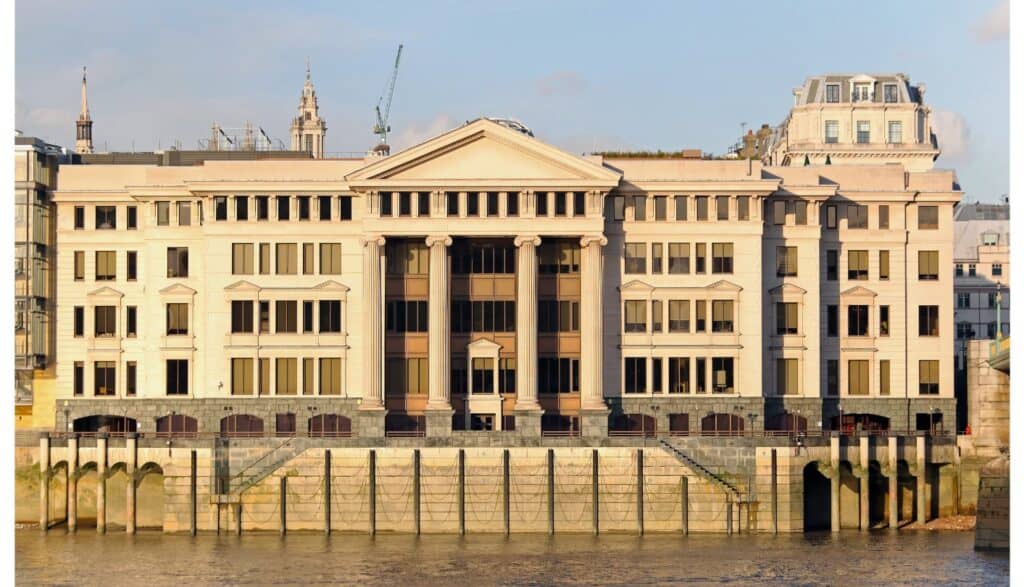
5 Churchill Place, Canary Wharf, London (E14)
Explore ACCL fibre installation services in Canary Wharf →Need high-density cabling that can flex with your business?
ACCL designed, installed and 100% Fluke-tested 22,000 outlets across four MF Global trading floors, then absorbed a 30% seating-plan change without a redesign. Talk to us about a similarly demanding project.
More than 1,000 kilometres of Leviton Cat6
MF Global standardised its new corporate infrastructure around a Leviton Category 6 structured cabling system. Approximately 644 miles, more than 1,000 kilometres, of Cat6 cable were installed to provide the 22,000 network outlets.
The quantity alone demonstrates the scale of the project, but installing this volume of cabling across four trading floors created another significant engineering challenge: the network infrastructure had to coexist with power, mechanical services and the building’s underfloor cooling system. Simply installing the required quantity of cable was not enough, the routes had to be designed and coordinated so that the network did not adversely affect the wider building environment.
Protecting the trading-floor cooling system
The trading floors relied upon an underfloor air cooling system. With substantial quantities of communications and power cabling beneath the raised floor, poorly managed cable routes could restrict the movement of cooled air and potentially create uneven temperatures across the trading environment.
ACCL therefore coordinated the structured cabling routes with the other building services to maintain effective airflow. Cable pathways were carefully planned and controlled rather than allowed to accumulate indiscriminately within the floor void, particularly important in a trading environment containing large quantities of heat-generating IT equipment. The network installation was treated as part of the wider building engineering environment rather than as an isolated cabling package.
Infrastructure designed around the trading desks
A conventional office cabling arrangement would not have been suitable for the density of technology required by MF Global. Dealer desks could accommodate as many as six computer systems, while individual trading positions could require up to eight network connections.
ACCL developed dedicated cabling and containment arrangements around the trading desk clusters to accommodate this density while keeping the infrastructure organised and manageable. Each desk cluster incorporated defined conduits routed back towards known central locations, meaning engineers could identify where individual cables terminated without having to lift substantial areas of the trading floor simply to locate cable endpoints, significant operational flexibility for an environment where trading teams and desk positions could change rapidly.
A 30% seating change put the design to the test
One of MF Global’s requirements from the outset was that the infrastructure should allow trading desks to be moved and reconfigured. That requirement was tested before the project was even completed. During delivery, MF Global decided that staff occupying the second and third floors would exchange locations. The resulting changes affected approximately 30% of the planned seating arrangements, on a network containing 22,000 connections, a substantial change.
Because flexibility had been incorporated into the infrastructure from the design stage, ACCL was able to accommodate the revised seating requirements without fundamentally redesigning the network.
100% Fluke tested
With an infrastructure of this scale, installation alone was not enough. Every copper and fibre connection installed by ACCL was Fluke tested prior to handover, providing verification of the installed infrastructure and giving MF Global confidence that the physical network supporting its trading operation had been comprehensively tested.
A project involving 22,000 outlets, four communications rooms, 20 APC cabinets and 15 Krone frames required a disciplined approach to testing, identification and documentation. Rather than relying upon sample testing, the copper and fibre infrastructure was comprehensively tested as part of the project handover process, leaving MF Global with a verified physical network foundation ready to support its active network equipment and trading systems.
Technologies used
Preparing for future wireless connectivity
MF Global initially chose to standardise on fixed network connections while planning to introduce wireless networking at a later stage. Rather than returning to the trading floors to install significant additional cabling once the building was operational, ACCL incorporated approximately 1,000 ceiling-level data points across the four floors.
These provided the physical infrastructure required for the subsequent deployment of wireless access points and other IP-connected technologies, an early example of an approach ACCL continues to advocate: design the passive infrastructure around both today’s requirements and tomorrow’s technology strategy.
Environmental considerations
The Canary Wharf building already had a strong environmental performance rating which MF Global wanted to maintain throughout the refurbishment. Environmental performance therefore formed part of the design process and the selection of contractors and suppliers. Careful coordination of more than 1,000 kilometres of structured cabling with the building’s underfloor cooling system was an important part of maintaining that objective, the project demonstrated that the physical network could not be considered independently from the environmental and mechanical performance of the building it served.
Phase two: connectivity beyond the trading floor
Following completion of the principal trading-floor infrastructure, MF Global moved into a second phase of development. Network connectivity was extended beyond the dealing areas and into other parts of the building, including staff breakout and deli areas, so employees could remain connected when away from their normal trading positions. The original infrastructure therefore evolved from a trading-floor cabling installation into a broader building-wide connectivity platform.
ACCL’s role
MF Global required considerably more than the installation of cable and outlets. ACCL provided a complete design, delivery and testing service, including:
- On-time, on-plan, within-budget delivery
- Installation of ~1,036km of Cat6 copper cabling
- Installation of 22,000 Leviton Cat6 data outlets
- Build-out of four coordinated communications rooms
- 100% Fluke testing of copper and fibre connections
- Coordination of cable routes with underfloor cooling
- Phase Two connectivity to breakout and communal areas
- Planning and design consultation ahead of installation
- Programme management within a sub-three-month schedule
- Installation of 20 APC data cabinets and 15 Krone frames
- Installation of ~2,000m of diversely routed 48-core fibre
- Dedicated containment design around trading desk clusters
- ~1,000 ceiling data points for future wireless deployment
- Accommodation of a 30% seating reconfiguration mid-project
- Design of the structured cabling and fibre-optic infrastructure
A landmark project in ACCL’s development
Delivered in 2002, just a few years after ACCL was established, MF Global represented an important milestone in the company’s development. Successfully delivering 22,000 network outlets and more than 1,000 kilometres of copper cabling within a programme of less than three months demonstrated that ACCL had already developed the project management, engineering and installation capabilities required for major enterprise network deployments.
More than two decades after its completion, MF Global remains a powerful example of ACCL’s ability to deliver large-scale, resilient and fully tested network infrastructure for business-critical environments, the difference between installing cabling and engineering network infrastructure.
Explore related ACCL services
Related guidance
Foreword by Wayne
“MF Global asked us to do something we hadn’t been asked to do at that scale before – twenty-two thousand outlets, four trading floors, and a programme that kept getting shorter while the scope kept getting bigger. What I remember most isn’t the size of the numbers, it’s that when around 30% of the seating plan changed partway through, the infrastructure just absorbed it. That’s what good design does – it survives contact with the real world. MF Global taught us early on that scale means nothing without discipline behind it, and it’s a lesson we’ve carried into every large project since.”Wayne Connors, Managing Director, ACCL
Frequently asked questions
How large was the MF Global network installation?
ACCL installed 22,000 Leviton Category 6 data outlets, approximately 1,036km of copper cabling and around 2,000 metres of diversely routed 48-core multimode fibre across four communications rooms.
How did ACCL accommodate the changing project scope?
The requirement grew from around 18,000 to 22,000 ports while the programme reduced to less than three months. Flexibility built into the design also allowed a seating change affecting around 30% of the planned layout without a fundamental network redesign.
How was the trading floor cooling protected?
ACCL coordinated the cable routes with other building services and carefully controlled the pathways beneath the raised floor so the large volume of communications cabling did not obstruct the underfloor cooling system.
How was the installation prepared for future wireless networking?
ACCL installed approximately 1,000 ceiling-level data points across the four floors, allowing future wireless access points to be deployed without returning later for extensive additional cabling.
What cabinet and frame infrastructure supported the network?
The four communications rooms incorporated 20 APC data cabinets and 15 Krone frames, supporting the copper and fibre distribution across the trading floors.
Was every connection tested before handover?
Yes. Every copper and fibre connection was 100% Fluke-tested, giving MF Global a fully verified network rather than a sample-tested installation.
Why was the fibre backbone diversely routed?
Rather than relying on a single physical cable pathway, ACCL built diversity into the backbone design to reduce the network’s exposure to a single cable-route failure, important for a financial trading environment where availability is fundamental to business operations.
How did MF Global’s trading desks differ from typical office cabling requirements?
Dealer desks could support as many as six computer systems, and individual trading positions could require up to eight network outlets, far denser than a conventional office cabling arrangement.
Did the underfloor cooling system limit how the cabling could be installed?
ACCL coordinated the structured cabling routes with the building’s other services so the volume of cable beneath the raised floor did not restrict the underfloor air cooling system.
Was the project delivered on time and within budget despite the scope increase?
Yes. Despite the port count growing from around 18,000 to 22,000 and the programme compressing to under three months, ACCL delivered the installation on time, to plan and within budget.
How significant was the MF Global project in ACCL’s history?
At the time, it was the largest structured cabling project ACCL had undertaken, and became an important milestone in the company’s development.

Planning a large-scale or mission-critical cabling project?
Talk to the team that delivered 22,000 outlets and over 1,000km of Cat6 cabling for MF Global’s Canary Wharf trading floors, on time and within budget.
Book a free site survey 0333 900 0101