The Challenge Facing Every School Planning a Tech Upgrade
School data cabling is at the heart of almost every technology upgrade we are called in to help with. It usually starts with one project. A school business manager calls us about replacing an ageing CCTV system. Or a bursar wants to upgrade the intercom on the front door. Or an IT manager has been asked to improve Wi-Fi coverage across the building ahead of September.
By the time we arrive on site, we often discover that these separate projects are actually interconnected. Each one is waiting on the same thing: the cabling.
This overlap is not a coincidence, but a result of the nature of older school buildings. While technology has advanced, the supporting infrastructure has often lagged behind.
Why School Buildings Make This Hard
Most schools in London and the South East were not designed with modern technology in mind. Victorian and Edwardian buildings with metre-thick walls, high ceilings and no cable voids were built for chalk and blackboards, not IP cameras and cloud-based management systems.
Over the decades, infrastructure has been added in layers. A phone system here. A CCTV system there. Wi-Fi access points bolted to corridor ceilings with cables running back to wherever was convenient at the time. The result is a building where the school data cabling is unknown, its condition uncertain, and whether it can support what the school wants to do next even less so.
Before any meaningful upgrade can happen, someone needs to assess what is actually there. That assessment is the free site survey, and in our experience, it is the most valuable hour a school can spend before committing to any technology budget.
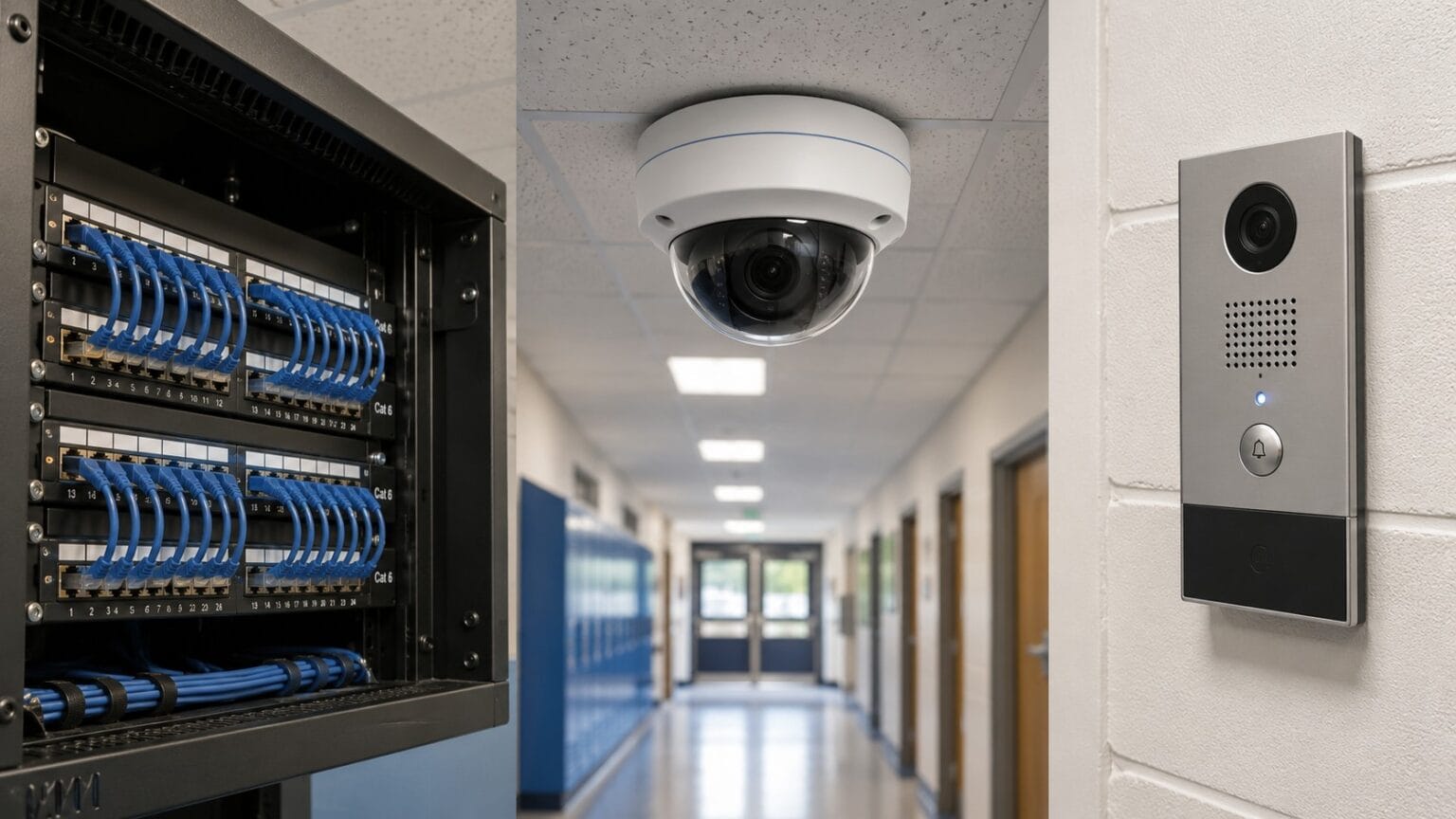
Why the Cabling Has to Come First
There are practical and financial reasons why school data cabling has to lead every infrastructure project.
The practical reason is routing. In a school building, cable routes through walls and ceiling voids, and conduit is limited and sometimes not obvious until someone is standing inside the building with a torch. Planning the routes for data, CCTV and intercom cabling together means one set of containment runs, one set of fixings, and one disruption to the building. Planning them separately means three separate contractors making three separate sets of decisions, often in conflict with each other.
The financial reason is labour. The highest cost in any cabling installation is not the cable itself but the time required to route, terminate, test and certify it. If data cabling goes in during July and a CCTV contractor arrives in August with no knowledge of which routes have already been used, you are effectively paying for the same access twice. A coordinated plan, scoped from a single survey, eliminates that entirely.
There is also a third reason that is often overlooked: documentation. A professional school data cabling installation produces a full test and certification report for every cable run, as well as updated as-built drawings showing exactly what is installed and where. That documentation becomes invaluable for every future project, every new IT manager and every contractor who comes after us.

What the Survey Actually Reveals
A school data cabling survey typically uncovers more than the client expects, and almost always in a useful rather than alarming way.
We assess the existing cabling infrastructure throughout the building, identifying what is there, its condition, and whether any of it can be reused. In many schools, coaxial cabling installed for analogue CCTV is surprisingly well maintained and can support IP camera upgrades using conversion equipment, which can significantly reduce costs.
We inspect and review the comms room or server cabinet, assessing how it is organised, which switching equipment is in place, whether there is capacity for the new systems being planned, and whether it needs tidying or upgrading as part of the wider project. A well-organised server room is the foundation of a reliable school network.
We walk the cable routes, inspecting ceiling voids, wall construction, existing trunking, and any constraints that affect how the work can be carried out. In older school buildings, this sometimes means identifying asbestos risk in ceiling voids, which needs to be formally assessed before any work begins. It also means understanding the layout of the school day, fire escape routes and any areas with restricted access.
Everything we find feeds directly into an accurate, itemised quotation, as well as the risk assessment and method statement required before any work can begin on a school site. These documents are a professional and legal requirement under Health and Safety Executive guidelines, and they cannot be prepared accurately without a proper survey of your building.

See it in practice: our ICT and security infrastructure project for Royal Russell School, Croydon shows this kind of summer upgrade delivered on a real campus. See also our structured data cabling hub, education sector page and schools page.
Frequently Asked Questions – (FAQs)
Q. Why does data cabling need to come before Wi-Fi, CCTV or intercom upgrades in schools?
Structured data cabling is the shared foundation for all of these systems. Planning cable routes for data, CCTV and intercoms together means one set of containment runs, one disruption to the building, and no duplicated labour costs. Doing them separately risks conflicting routes and paying for building access multiple times.
Q. What cabling standard should a school use for a new installation?
Cat6 or Cat6a is the recommended standard for school data cabling installations. Cat6a in particular supports higher speeds and longer runs, making it a more future-proof choice for schools planning to add IP CCTV, access control or additional Wi-Fi access points over time.
Q. Can existing coaxial CCTV cabling be reused when upgrading to IP cameras?
In many cases, yes. Coaxial cabling in good condition can support IP camera upgrades using conversion equipment, which can significantly reduce costs. A site survey will confirm whether your existing coax is suitable for reuse.
Q. How long does a school cabling project take, and can it be completed in the summer holidays?
Most school cabling projects can be completed within the six to eight week summer holiday window, provided planning begins in spring. Surveys, quotations, risk assessments and method statements all need to be in place before work can start, so early preparation is essential.
Q. When should a school start planning a summer cabling upgrade?
Ideally in April or May. Starting the conversation in spring means a full quotation and documentation package is ready before the end of term, work can be scheduled, and engineers are on site from the first day of the holidays.
Q. What does a free school data cabling site survey include?
A free site survey takes between 30 minutes and one hour and covers an assessment of existing cabling infrastructure, an inspection of the comms room or server cabinet, a walk of cable routes through the building, and identification of any constraints such as asbestos risk in ceiling voids. The findings feed into an accurate, itemised quotation along with the risk assessment and method statement required before work begins. There is no obligation to proceed.
Q. Can a school phase its cabling and technology upgrade across multiple years?
Yes. A well-planned initial cabling installation lays the foundation for everything that follows. A typical phased approach might cover structured cabling and Wi-Fi in year one, IP CCTV in year two, and IP intercoms and entry phones in year three. The key is that the initial installation is planned with all phases in mind so nothing needs reworking later.
Q. What documentation should a professional school cabling installation produce?
A professional installation should produce a full test and certification report for every cable run, along with updated as-built drawings showing exactly what is installed and where. This documentation is invaluable for future projects, new IT managers, and any contractors who carry out subsequent work on the site.


Written by
Wayne founded ACCL in 1997 and has led more than 28 years of project delivery, helping organisations design, install and modernise the network infrastructure behind reliable connectivity, office moves and refurbishments. His experience spans copper cabling, fibre backbones, data centre infrastructure, Wi-Fi, CCTV and access control. About ACCL