Fluke cable testing is about proof, not appearances
Fluke cable testing gives a commercial client evidence that the copper links included within the agreed scope have been measured against the correct certification standard and test limit. For IT managers, facilities teams and project leads, that matters because a neat-looking installation can still fall short of the performance required at handover.
A new outlet can show basic connectivity and still fall short of the category or Class it was specified to achieve. Poor termination, excessive untwist, damaged cable, inconsistent pair geometry, unsuitable routing or hidden link faults can all affect high-frequency performance in ways that visual checks and simple continuity testing do not reveal.
This guide is written for IT and facilities teams planning or reviewing commercial structured cabling projects. The key question is not whether a contractor owns a tester; it is whether every installed link has been certified against the right limit, whether failures were resolved, and whether the final records are clear enough to support future changes, fault-finding and handover confidence.
A cabling test report should be more than a green PASS screen. It should give the client traceable evidence of what was tested, which limit was applied and how the completed installation can be managed in the future.
— ACCL testing and handover standard
Verification, qualification and certification answer different questions
These terms are often used interchangeably in project conversations, but they do not mean the same thing. For a commercial client assessing new cabling, understanding the difference helps separate a basic check from standards-based certification evidence.
- Verification — basic fault checks such as opens, shorts, crossed pairs and wire-map issues. Useful during installation, but it does not prove standards compliance.
- Qualification — assesses whether an existing link is likely to support a stated network speed or application. Useful for troubleshooting and reuse decisions, but not a substitute for certification.
- Certification — measures the installed link against a selected cabling standard and test limit, producing a PASS or FAIL result with the detailed performance data needed for handover and compliance evidence.
For new commercial cabling, certification is the result that matters
On a new installation, certification is the process that demonstrates whether the fixed cabling link met the specified category or Class at the time of test. It also creates the structured record needed for handover, future changes, fault investigation and, where applicable, manufacturer warranty support.
Certification measures performance, not just connectivity
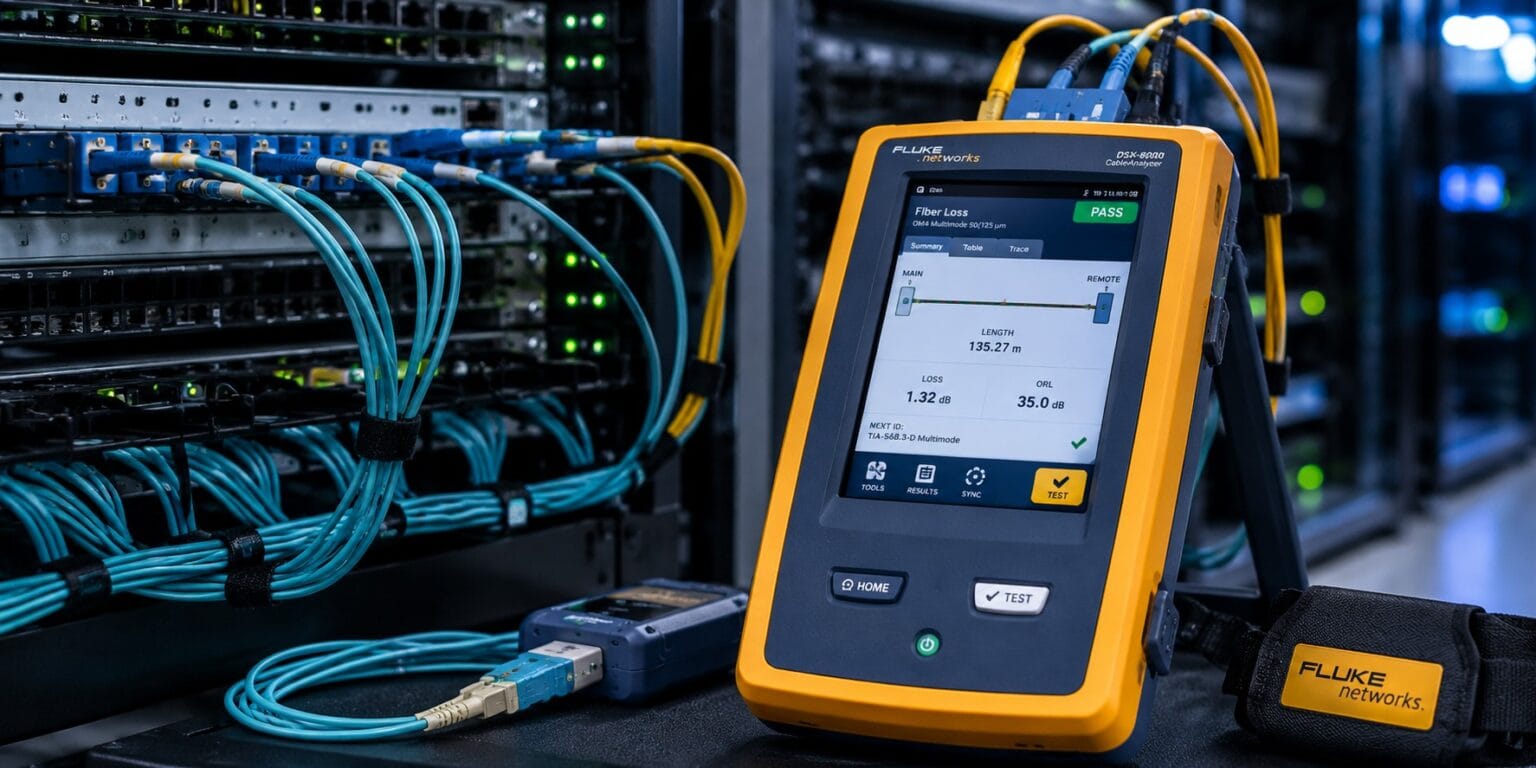
Copper certification testing assesses the installed link across the frequency range required by the selected standard. The exact results vary by limit, but a Fluke cable certification report typically includes wire map, length, insertion loss, crosstalk and return loss, alongside the overall PASS or FAIL result.
| What’s tested | What it checks |
|---|---|
| Wire map and continuity | Checks that the pairs are connected correctly and identifies faults such as opens, shorts, reversals and split pairs. |
| Length | Records the measured link length and helps identify routes that may exceed the intended design allowance. |
| Insertion loss | Assesses how much signal strength is lost as data travels through the installed link. |
| Near-end crosstalk | Checks interference between pairs at the transmitting end of the link. |
| Return loss | Assesses signal reflections that can arise from poor termination or inconsistent impedance. |
| Result and diagnostics | Records the selected limit, PASS or FAIL status and the detailed evidence needed to investigate exceptions. |
Certification confirms the outcome of the installation. It cannot compensate for poor component choice, bad cable handling or weak termination practice, which is why installation discipline still plays a major role in whether a link passes first time and remains supportable after handover.
Why commercial cabling is commonly certified as a permanent link
The permanent link is the fixed portion of the cabling system between the patch panel and the outlet or consolidation point. It excludes the removable patch leads used to connect active equipment. In commercial structured cabling projects, this is usually the part installed and controlled by the cabling contractor.
Permanent-link certification gives the client evidence that the fixed infrastructure was installed to the stated standard. Patch cords can be changed later, but concealed cable routes and field terminations are far more disruptive and expensive to revisit once the building is occupied.
Ask exactly what basis the testing covers
A report should make clear whether results relate to a permanent link or a channel. Both approaches can be valid, but they are not interchangeable. The correct choice depends on the project scope, the installed components and any consultant, client or manufacturer requirements.

Questions to ask before appointing a cabling contractor
Testing should be agreed before installation starts, not added at the end as an extra. These questions help clients compare proposals on a like-for-like basis and avoid assumptions around sampling, limits and reporting quality.
- Will every installed link be certified, or only a sample?
- Which test limit will be used for the specified cabling category or Class?
- Will testing be completed as a permanent link, a channel or another agreed configuration?
- Will tester calibration status and test equipment details be documented where required?
- Will the report use the same identifiers as the outlet labels and cable schedule?
- What is the agreed process for failures and exceptions?
What Fluke cable testing does not prove on its own
Certification is critical evidence for the physical cabling layer, but it should not be presented as proof that every service, device or application in a building will perform perfectly. It confirms the installed link against the selected cabling standard and test limit at the time of test.
- It does not test the whole network — switch configuration, internet connectivity, firewall settings, Wi-Fi design and application performance sit outside the scope of a copper certification report.
- It does not replace a Wi-Fi survey — good cabling supports access points, but coverage, capacity and roaming depend on separate wireless design and validation work.
- It does not fix poor documentation — a PASS result is much less useful when it cannot be matched to a labelled outlet, patch-panel port or as-built record.
- It does not remove future maintenance needs — patch leads, active equipment and later changes can still introduce faults, even when the fixed permanent link was correctly certified at handover.
Testing should be built into delivery, not added at the end
ACCL designs, installs, certifies and documents commercial network infrastructure as one accountable scope. The aim is not to create paperwork for its own sake, but to give clients evidence they can rely on at handover and records they can still use when the building changes.
That approach supports the ACCL +3dB performance-headroom standard. A formal PASS against the agreed test limit remains essential, but ACCL treats certification quality, installation discipline and clear handover evidence as part of the same delivery standard.
What ACCL includes
Survey, design, installation, per-link certification, clear labels and useful handover documentation. One accountable scope from first visit to final records.
Explore the infrastructure behind the test report
- Structured data cabling
- Office cabling
- Cable testing and certification guide
- The +3dB performance-headroom standard
- Commercial Wi-Fi installation
- Wi-Fi site surveys
- Fibre optic installation
- Data cabinet tidy
- Book a free site survey
Technical references
These external references support the testing terminology used in this guide.
Frequently Asked Questions – (FAQs)
Q. What is Fluke cable testing?
Fluke cable testing is the use of Fluke Networks equipment to verify, qualify or certify copper cabling. On new commercial structured cabling projects, certification testing is the process used to assess each installed link against the agreed standard and test limit.
Q. Does every new cable need to be Fluke tested?
The testing requirement should be defined in the project scope before work starts. For commercial structured cabling, ACCL recommends individual certification of installed links rather than relying on visual checks or limited sampling, especially where full handover evidence is required.
Q. What is the difference between a cable tester and a cable certifier?
A basic cable tester identifies simple continuity and wire-map faults. A cable certifier measures the installed link against selected standards-based performance limits and produces the detailed PASS or FAIL evidence needed for formal certification.
Q. Does a PASS result guarantee fast Wi-Fi?
No. A certified cable link gives the wireless system a compliant physical connection, but Wi-Fi performance also depends on access-point placement, radio design, switching, internet connectivity, configuration and client demand.
Q. What should I receive after cable testing is complete?
You should receive individual test results aligned to the installed labels and agreed scope, plus relevant cable schedules and as-built information where included. For qualifying projects, the handover pack may also support the applicable manufacturer warranty process.


Written by
Wayne founded ACCL in 1997 and has led more than 28 years of project delivery, helping organisations design, install and modernise the network infrastructure behind reliable connectivity, office moves and refurbishments. His experience spans copper cabling, fibre backbones, data centre infrastructure, Wi-Fi, CCTV and access control. About ACCL