King's Cross Gasworks Tunnel, London: rail fibre infrastructure
A ruggedised fibre backbone delivering millimetre-precision structural monitoring inside a reawakened Victorian rail tunnel.
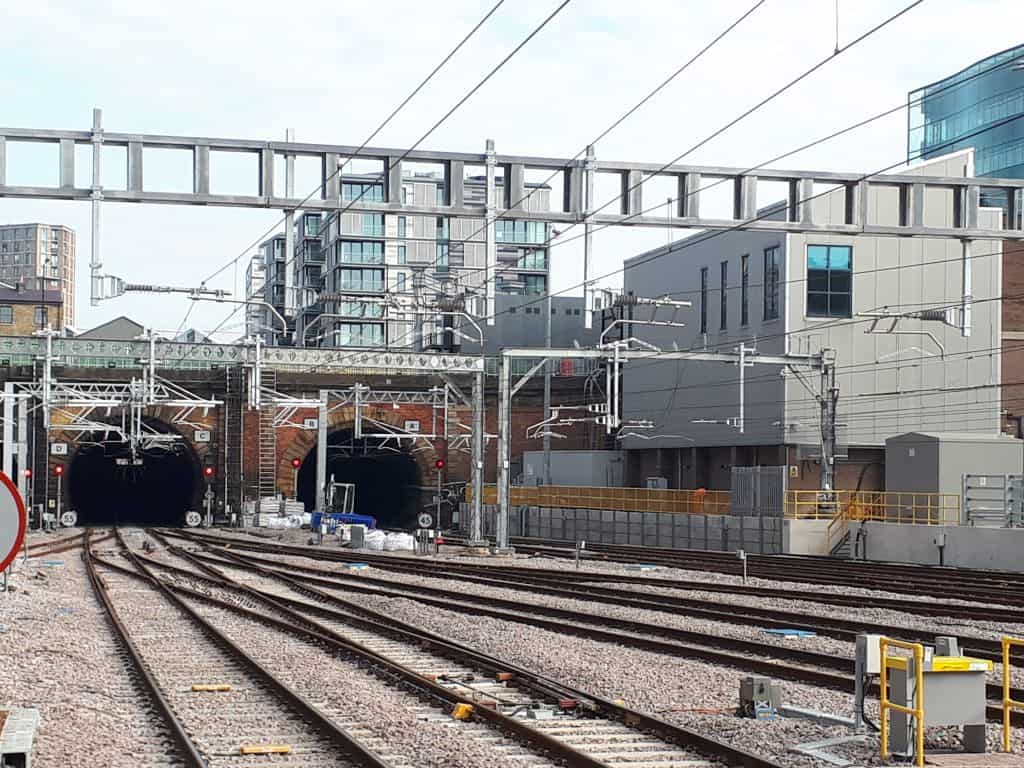
ACCL designed and installed a ruggedised fibre optic backbone inside King’s Cross’s dormant Gasworks Tunnel, connecting five wall-mounted total stations to deliver millimetre-precision structural monitoring as Network Rail reinstated the tunnel’s long-closed third bore. The network was procured, installed and made operational within two weeks, with zero mobile signal in the tunnel ruling out any other option.
The result
ACCL delivered the fibre backbone behind one of King’s Cross’s most significant capacity upgrades in over half a century. The completed network provided the project with:
- Rapid procurement-to-installation, operational within two weeks
- Single-millimetre precision prism monitoring scanned every 15 minutes
- Continuous, uninterrupted structural monitoring throughout excavation
- Zero unplanned closures to operational rail lines
- Comms fully independent of public networks, with zero mobile signal in the tunnel
- A fibre system that has remained accurate, reliable and maintenance-free
Services delivered
Overview
King’s Cross Station, one of London’s busiest transport hubs, has long been constrained by a track bottleneck, with 12 tracks reducing to four within a single 100-metre section. A major Network Rail redevelopment addressed that bottleneck by reinstating the historic Gasworks Tunnel’s third eastern bore, alongside the operational western and central bores, increasing track capacity by 50 per cent, renewing life-expired track, adding higher-speed turnouts, new drainage and improving journey times.
The eastern bore had been out of use since 1977, used as a dumping ground for thousands of tonnes of spoil. ACCL was commissioned by Amey to design and install a fibre optic communications backbone connecting precision monitoring instruments inside the redundant tunnel, delivering real-time structural movement data to engineers so excavation and redevelopment could proceed with confidence in the tunnel’s structural integrity.
The challenge
This was a complex engineering environment demanding ultra-precise structural monitoring during excavation and refurbishment, directly alongside live, operational rail tunnels. The Victorian masonry and cast-iron tunnel frames were sensitive to disturbance, and Regent’s Canal ran directly above part of the bore, raising the stakes on any risk of ground heave or movement.
Around 11,000 tonnes of spoil had to be removed from the redundant tunnel, with multiple third-party works taking place above other tunnel sections at the same time. Inside the tunnel there was zero mobile phone signal, ruling out any standard wireless communications option. ACCL also had to make sure the newly installed fibre could not be mistaken for redundant legacy cabling by other contractors working in the same space.
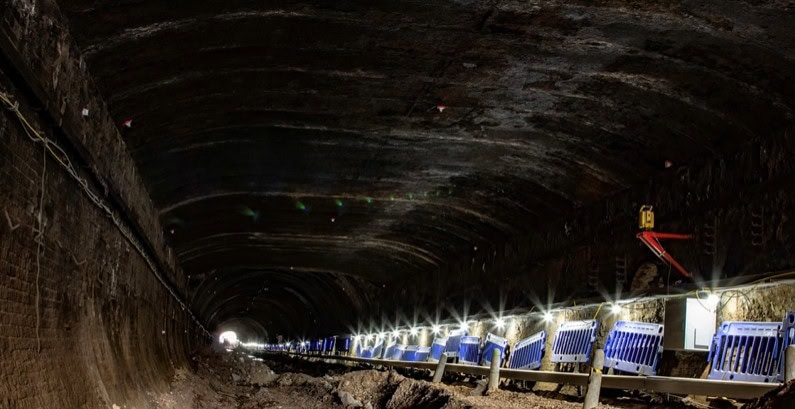
Mapping a fibre pathway through a dormant tunnel
ACCL carried out a comprehensive site survey and risk assessment to map the tunnel environment and specify the optimal pathway for the fibre runs. Ruggedised fibre optic cable, built to withstand moisture, vibration and physical wear, was then installed and routed to a secure cabinet at each of five wall-mounted total stations.
Precision termination and testing guaranteed bandwidth and signal integrity over the tunnel’s full length, and the work was coordinated with tunnel engineers and site managers so installation could take place during low-activity windows, across both day and night shifts.
Need precision monitoring in a live rail or tunnel environment?
ACCL delivered a ruggedised fibre backbone connecting five total stations inside a dormant Victorian tunnel, operational within two weeks and with zero unplanned closures. Talk to us about a similarly demanding rail or infrastructure environment.
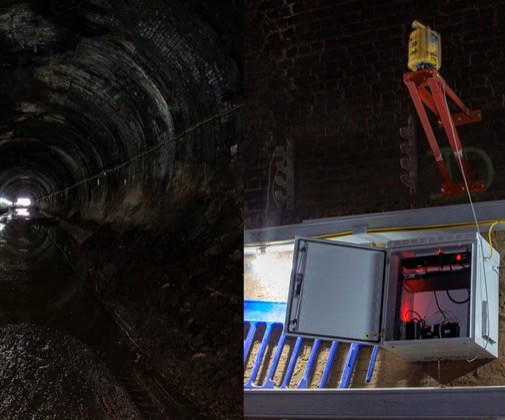
Millimetre-precision monitoring, day and night
Once live, the network delivered single-millimetre precision prism monitoring, scanned at 15-minute intervals, giving engineers continuous, uninterrupted assurance over the tunnel’s stability throughout excavation and structural works.
ACCL worked around 42 redundant prisms and abandoned monitoring schemes left from earlier decades without interference, and delivered the installation under both day and night shift regimes, with strict safety protocols in these confined spaces.
Built for a tunnel with no signal
Because the tunnel carried zero mobile phone coverage, any monitoring system reliant on wireless or cellular connectivity was ruled out from the start. ACCL’s ruggedised fibre network gave the total stations a communications backbone that was completely independent of public networks, eliminating any risk of comms degradation under adverse site conditions.
The team also had to protect the new fibre itself. With legacy monitoring equipment and cabling already present from earlier decades, ACCL used a clear identification and routing strategy so the newly installed fibre could not be mistaken for redundant infrastructure by other contractors working in the tunnel.
Technologies used
ACCL’s role
This project needed more than routing cable through a tunnel. ACCL’s scope covered:
- Conducting a full site survey and risk assessment of the tunnel environment
- Specifying the optimal fibre pathway through a live construction site
- Installing ruggedised fibre optic cable to five wall-mounted total stations
- Precision termination and testing for long-distance signal integrity
- Coordinating installation around live operational rail tunnels
- Delivering work across day and night shifts in confined spaces
- Protecting new fibre from misidentification as legacy cabling
- Supporting millimetre-precision structural monitoring throughout excavation
Why the project matters
King’s Cross Gasworks Tunnel shows ACCL delivering mission-critical connectivity where there was no margin for error: live rail tunnels running alongside the works, a canal overhead, and zero mobile signal underground. The fibre network had to work first time, with no scope for a slow fix once excavation was underway.
It also shows fibre optic cabling doing far more than carrying data. Here, it was the backbone for real-time structural monitoring that gave engineers the confidence to excavate safely beneath one of London’s busiest and most historic transport hubs.
Related guidance
Foreword by Wayne

“King’s Cross Gasworks Tunnel is one of my favourite examples of what a fibre network actually does on a project like this: it is not just data, it is the thing that let engineers trust what was happening underground. Zero mobile signal, live tunnels either side, Regent’s Canal sitting above part of the bore. If the monitoring network had gone down, the whole excavation would have had to stop. What I’m proud of is the pace: procured, installed and operational within two weeks, connecting five total stations to a network that has since run maintenance-free. That only happens when the team doing the physical install understands exactly what the monitoring engineers need from the data, not just where to run a cable.”Wayne Connors, Managing Director, ACCL
“The team at ACCL designed and installed what is still a very top class and reliable comms array, so all the fibre optic cabling within the tunnel.”Amey Consulting
Frequently asked questions
What did ACCL deliver at King’s Cross Gasworks Tunnel?
ACCL designed and installed a fibre optic communications backbone connecting precision monitoring instruments inside the redundant eastern bore of the Gasworks Tunnel, delivering real-time structural movement data to engineers.
What is the King’s Cross Gasworks Tunnel?
It is a historic three-bore rail tunnel at King’s Cross. The eastern bore had sat dormant since the 1950s until Network Rail reinstated it as part of a redevelopment increasing track capacity by 50 per cent.
Who was ACCL’s client on this project?
ACCL was commissioned by Amey as part of the wider Network Rail redevelopment of King’s Cross Station.
Why couldn’t the monitoring system use mobile or wireless connectivity?
There was zero mobile phone signal inside the tunnel, which ruled out any standard wireless communications option and made a ruggedised fibre network the only viable choice.
How precise was the structural monitoring?
The network supported single-millimetre precision prism monitoring, scanned at 15-minute intervals throughout excavation and structural works.
How long did the installation take?
The fibre network was procured, installed and made fully operational within two weeks.
How many total stations did the fibre network connect?
The network connected five wall-mounted total stations, each routed to a secure cabinet via ruggedised fibre optic cable.
What made this a challenging environment?
The works ran alongside live operational rail tunnels, beneath sensitive Victorian masonry with Regent’s Canal directly above part of the bore, and required removing around 11,000 tonnes of spoil, all with zero mobile signal underground.
Did the fibre network cause any disruption to rail services?
No. The project supported excavation and structural works with zero unplanned closures to operational lines.
How did ACCL avoid confusion with legacy tunnel cabling?
ACCL used a clear identification and routing strategy, working around 42 redundant prisms and abandoned monitoring schemes so the new fibre could not be mistaken for legacy infrastructure.
Was the work carried out during the day or night?
Both. Installation was delivered under day and night shift regimes, with strict safety protocols in the tunnel’s confined spaces.
Need mission-critical fibre in a live rail or infrastructure environment?
Talk to the team that delivered millimetre-precision monitoring inside King’s Cross Gasworks Tunnel, operational within two weeks and with zero unplanned closures.
Book a free site survey 0333 900 0101Image credits
Hero image: King’s Cross Gasworks Tunnel portals beneath Regent’s Canal, Stephen Craven, via Wikimedia Commons, CC BY-SA 2.0.

Active Communication Company Ltd trades as ACCL, ACCL Data Cabling London and ACCL Data Cabling Kent · Commercial data cabling and network infrastructure specialists