
Rapid 5G connectivity for 36 temporary construction sites
ACCL designed and rolled out a single, repeatable connectivity build that kept Mulalley’s fast-moving construction sites online from day one, without waiting for fixed-line broadband.
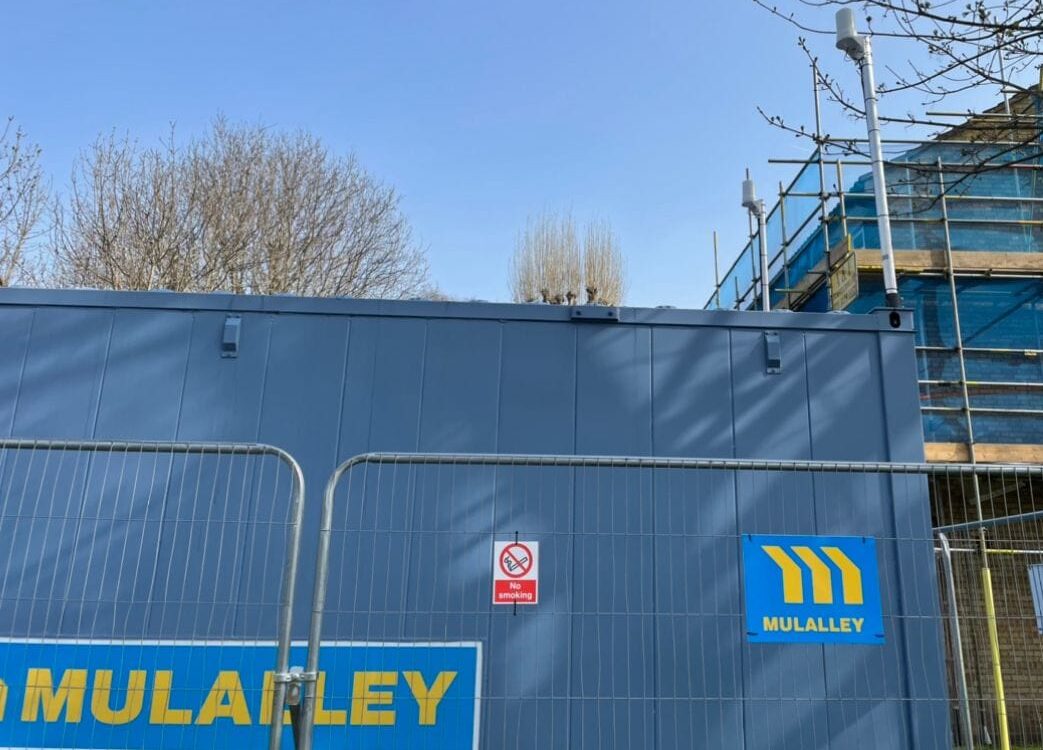
ACCL was engaged to connect Mulalley’s temporary site offices as they were stood up across London in quick succession. Rather than treat each cabin as a one-off, we designed one standardised connectivity build and repeated it on every site, delivering reliable business-grade internet to 36 locations in around two months.
The result
- No fixed lines and no ISP lead time on any site
- Compact 9U wall-mounted cabinet in every cabin
- Roof-mounted external antenna for stable 5G signal
- Cat6 outlets to every desk position
- WiFi access points cabled back to the switch
- Equipment recovered and redeployed as sites closed
Services Delivered
Overview
Mulalley & Co. Limited is a family-owned construction and regeneration contractor based in Woodford Green, working across London and the South East. As part of a large programme, Mulalley was standing up temporary construction sites across London in quick succession, each needing a working site office from the moment its cabins were positioned.
ACCL was engaged to connect those site offices. Rather than treat each cabin as a one-off, we designed one standardised connectivity build and repeated it on every site, delivering reliable business-grade internet to 36 locations in around two months.
The challenge
Mulalley’s sites were coming online faster than internet service providers could serve them. Each site was temporary, and a fixed-line connection carries a lead time measured in weeks, so an install date could not keep pace with the programme. Waiting for a fixed line would have left site teams without connectivity for the very period they most needed it.
Site staff needed reliable internet straight away, for everything from drawings and email to procurement and resident liaison. With sites opening and closing continually, every day of delay carried a cost, and the connectivity could not be allowed to hold up mobilisation.
Project context
Temporary construction sites are one of the hardest environments to connect. They are needed at short notice, they move, and they close again, which is exactly the pattern fixed-line broadband is least suited to. A mobile-first approach removes the dependency on a physical line being provisioned at each address, and pairing it with proper on-site structured cabling gives site teams the same wired and wireless experience they would expect in a permanent office.
Structured data cablingNeed connectivity on a site that is moving faster than the ISPs?
ACCL designs standardised, repeatable builds that bring temporary sites online the day the cabins land.

One build, repeated everywhere
ACCL designed a single connectivity build that could be dropped onto any site, whatever its location. Each portacabin was fitted with a compact 9U wall-mounted cabinet housing a 5G router and a network switch. Standardising the build was the key decision: it made every site quick to install, predictable to support, and simple to decommission and redeploy.
The router takes its internet connection over the mobile 5G network rather than a fixed line, which removes the ISP provisioning lead time completely, allowing a site to be online the same day its cabin was positioned.

Cat6 outlets at every desk, and a roof-mounted antenna for a stable signal
From the cabinet, we installed Cat6 data outlets to every desk position, each labelled and tested, and cabled Cat6 back to the wireless access points, giving site staff reliable wired connections alongside full WiFi coverage. Because every cabin was built to the same specification, the network behaved identically on every site.
The metal structure of a portacabin weakens mobile signal. To secure the strongest and most stable connection, we ran coaxial cable from the router up to an external antenna mounted on the roof of the cabin, lifting the aerial clear of the cabin for far better reception than an indoor unit could achieve.
Delivery and the outcome
Speed and repeatability were everything. Because the build was standardised, the limiting factor was never ACCL, it was the logistics of getting the cabins onto each site. Some days a single cabin could be positioned and brought online; on others, two sites were installed. Over roughly two months, ACCL completed all 36 sites across London.
Every Mulalley site had reliable internet from day one, with no dependence on fixed-line availability and no delay to site mobilisation. Because each cabin was built to an identical specification, the network was straightforward to support, and equipment could be recovered and redeployed as temporary sites closed and new ones opened.
Technologies Used
ACCL’s role
ACCL designed the standardised build, supplied and installed the cabinet, router, switch, antenna and cabling on every site, and configured each cabin so it was handed over as a live, working network. Working to a single repeatable specification is what allowed us to keep pace with an unpredictable delivery schedule and connect 36 sites in around two months.
- Designed the standardised connectivity build
- Supplied and installed cabinet, router and switch
- Installed roof-mounted antenna and coaxial feed
- Installed Cat6 to desks and wireless access points
- Handed over each cabin as a live, working network
- Recovered and redeployed equipment as sites changed
Foreword by Wayne
“When sites are mobilising this quickly, the connectivity has to be there on day one, and a fixed line simply cannot move at that pace. By standardising the build around 5G and a compact cabinet in every cabin, we gave Mulalley’s teams a reliable, business-grade network the moment each cabin was positioned. Rolling that out across 36 sites in two months came down to a repeatable design and a team that could turn a cabin around the same day it landed.”Wayne Connors, Managing Director, ACCL
Why use 5G instead of a fixed broadband line on a construction site?
A fixed line usually takes weeks to provision, which does not suit temporary sites that open and close quickly. A 5G router draws its connection over the mobile network, so a site can be online the same day the cabin is positioned, with no ISP lead time.
How quickly can a site be brought online?
Because the build is standardised, a cabin can be fitted out and handed over as a live, working network on the same day it is positioned. On this programme the pace was set by cabin logistics rather than the installation, with one or two sites brought online per day.
What is housed in the 9U cabinet?
Each cabin has a compact 9U wall-mounted cabinet containing the 5G router and a network switch, keeping the active equipment tidy, secure and in one place.
Why is the antenna mounted on the roof?
The metal structure of a portacabin weakens mobile signal. Running coaxial cable from the router to an external antenna on the roof lifts the aerial clear of the cabin, giving a stronger and more stable 5G connection than an indoor unit could achieve.
What cabling is installed inside the cabin?
We install Cat6 data outlets to every desk position and run Cat6 to the wireless access points, giving site staff reliable wired connections alongside full WiFi coverage throughout the cabin.
Is a 5G connection reliable enough for a working site office?
Yes. With a properly sited external antenna and a business-grade router and switch, a 5G connection supports day-to-day site work such as email, drawings, procurement and resident liaison.
What happens to the equipment when a temporary site closes?
Because every cabin is built to the same specification, the equipment is straightforward to decommission and redeploy. Kit can be recovered from a closing site and reused as new temporary sites open.
Can the same setup be scaled across many sites at once?
Yes. A single repeatable design is what makes scale possible. On this project ACCL delivered 36 sites across London in roughly two months, with each cabin built to an identical specification.
Can ACCL also install CCTV or access control on a temporary site?
Yes. Alongside cabling and WiFi, ACCL installs commercial CCTV and access control, so security systems can be added to a site build where they are needed.
Does ACCL cover my area?
ACCL is a BICSI and SSAIB accredited structured cabling and network infrastructure contractor serving London, Kent, Surrey and the South East.

Ready to connect your sites?
Whether you are running a single temporary office or a rolling programme of sites, ACCL can design a standardised connectivity build that keeps your teams online from day one.
Book a free site survey 0333 900 0101