In the UK, point-to-point wireless links are being deployed increasingly often, both in busy urban areas, such as London and Manchester, and in more remote areas. Free-to-air installation is getting more and more popular.
The initial wave of adoption was driven by companies that needed to interconnect nearby offices, but could not obtain the approvals required to install their own cables. In time, though, the reasoning diversified. Point-to-point wireless links, such as FSO and microwave links, offer an interesting compromise between the convenience of a wired link and the speed, security and flexibility of a wired connection.
When should you consider using FSO or microwave links? Point-to-point wireless links can match dedicated wired links in terms of speed and reliability, but they are usually more expensive to operate and maintain. What makes this solution so compelling?
Most businesses that rely on point-to-point wireless links do so for reasons such as:
- They are unable to get the approvals required to install their own cabling infrastructure, or would rather avoid the waiting and the legal hassle involved.
- They operate in areas where leased lines are expensive enough that operating your own equipment is a compelling option in financial terms. The additional flexibility and independence that they get from controlling their infrastructure also offsets some of the maintenance costs.
- They operate over long distances (over 5-10 km) that are not feasibly covered with dedicated wired infrastructure, and available leased-line options do not meet their requirements.
- They have specific security or performance (especially latency) requirements that cannot be satisfied by leased lines
If you find yourself in one of these situations, installing a point-to-point wireless link is one of the options that you may want to look into.
Alternatively, for environments where laying cables is feasible and a high level of data transmission efficiency is required, Passive Optical Networks (PONs) present a compelling solution.
Not sure if it’s the right call for you? Take a look at our dedicated service and schedule your FREE, no-obligations survey with us!
Line-of-sight (LoS) vs. non-line-of-sight (NLoS) transmission is the distinction that is most easily made. Some means of transmission work only as long as there is a direct, unobstructed “line of sight” between the antennas of the receiver and the transmitter.
This requirement puts a cap on:
- After a certain distance (which depends on the height of the two antennae), the Earth’s natural curvature causes the two antennae to become invisible to each other. An observer sitting on top of one antenna would not be able to see the other one, because it’s below the horizon.
- Deployment environment. Even over short enough distances, there are obstacles, such as tall hills or broad, tightly-packed groups of tall buildings that render the antennae invisible to each other.
Non-LoS methods do not require a direct, unobstructed line of sight between the two endpoints. However, most non-LoS methods do rely on LoS communication with intermediary nodes called repeaters — so you can think of non-LoS communication as being achieved, more or less, by “stringing together” several LoS sections.
Optical vs. microwave/RF links. Wireless data transmission over non-trivial distances can be carried out by two means, and both of them rely on sending data using electromagnetic waves.
One option is to send data encoded in pulses of light; the other is to send data over a stream of radio waves — typically, though not necessarily, in the microwave region of the spectrum.
Free-Space Optical (FSO) links are the most widely-deployed solution that relies on optic data transmission. FSO links are fast, line-of-sight links with several useful properties.
Microwave links may use line-of-sight paths or engineered relay arrangements. Feasible distance depends on frequency, path clearance, terrain, antennas, permitted power, fade margin, capacity and availability targets; it should be established through path engineering rather than a generic maximum.
Licensed vs. License-Free/Unlicensed operation. UK spectrum use is governed by current Ofcom licensing and licence-exemption rules. Each band can carry conditions covering purpose, EIRP, location, coordination and technical controls; licence-exempt does not simply mean operation below one power threshold. The appropriate route depends on interference risk, capacity and availability requirements and must be checked for the proposed equipment and sites.
Three technologies see significant use in the UK today, and we are going to discuss each one of them. These technologies are:
- Free-Space Optical (FSO) links
- Short-distance microwave bridges
- Long-distance microwave link
Free-Space Optical (FSO) Links
FSO is an optic, line-of-sight, license-free data transmission method which uses a tightly-focused beam of light to transmit data between two endpoints. More to the point, it transmits data by modulating a laser beam.
If you think this sounds an awful lot like fiber optics, you’re right — except that signals are transmitted through air, rather than through a dedicated transmission medium. The lack of a dedicated transmission medium (i.e. the cable, made from a material with special optical properties) that you can bend and route in order to guide the light means that there has to be a free, straight path between the two endpoints. But it also means that there is no fibre cable to bury or break.
FSO links use light beams at specific wavelengths in the infrared spectrum, between 750 nm and 1550 nm. These values are not chosen at random — they are chosen so as to be safe for the skin and eyes, and to guarantee good signal propagation properties.
Speed. FSO throughput is product- and configuration-specific. Compare current vendor data against the required usable capacity, interfaces, distance and atmospheric availability rather than relying on a fixed list of line rates.
Distance. FSO distance and availability depend on the selected optics, alignment, path length, local fog and precipitation data, building movement and the required fade margin. A link should be engineered from product data and site-specific atmospheric conditions.
Reliability. Historically, the reliability of FSO transmission used to be frequently brought into question. However, modern FSO technology can offer carrier-grade reliability over distances typical for urban deployment. Where absolutely necessary, FSO links can be deployed along with a redundant, RF-based LoS solution (i.e. a microwave uplink).
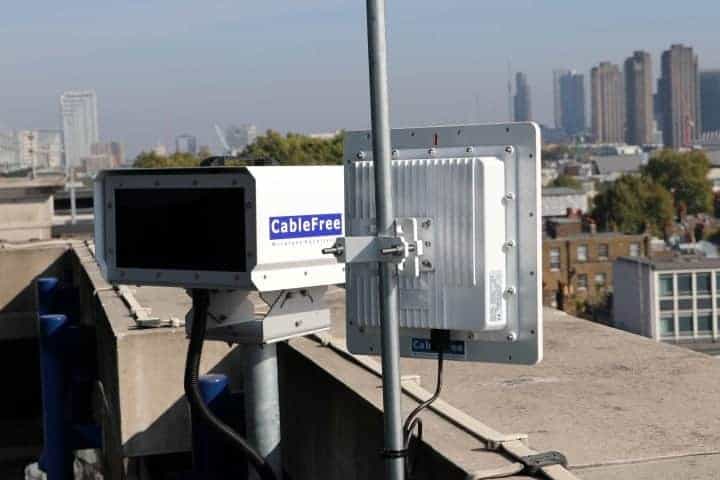
Equipment. FSO links use remarkably compact, self-contained equipment. You will need to install a FSO laser link device at each communication endpoint. This device incorporates both the transmitter and the receiver, and looks somewhat like a bulky CCTV camera.
The only major installation hurdle is that it needs to be tightly secured in place, on a stable surface, so that its beam can be aligned to the receiver at the other end. This is why FSO emitters typically cannot be installed on top of poles and are rarely used for mobile or portable units.

Long-Distance Microwave Links
Long-distance microwave links are non-LoS, RF, point-to-point links that carry data over RF waves in the microwave spectrum over long, non-LoS distances. This is achieved by using relays or repeaters — radio devices which receive and relay microwave links to other relays or endpoint devices — stringed together to cover the necessary distance.
There are both licensed and unlicensed spectrum regions available for long-distance microwave links. Most business users prefer the unlicensed regions, but operation in a licensed region can offer additional guarantees regarding the absence of radio interference.
Speed. Long-distance microwave platforms support a range of capacities. Achievable throughput, hop length and availability are interdependent and must be engineered from the licensed or exempt band, channel width, terrain, antenna system, fade margin, relay design and current vendor specifications.
Reliability. Long-distance microwave links are highly reliable — in fact, they are often used by mobile carriers. However, operation in a license-free area of the spectrum comes with no guarantees regarding interference with other equipment. As the distance increases, so does the chance of interference from other devices.
Equipment. In addition to the equipment required for a LoS microwave link, you will also need to install microwave relays at several points between the two communication endpoints. The relays, consisting of a radio unit and (at least) one antenna, are usually pole-mounted.
What Is the Best Option?
None of these options are universal. When deciding which one to pick, you should consider your requirements in terms of distance, performance, uptime requirements, as well as the budget you have for purchasing and maintaining equipment.
That being said, here are a couple of broad guidelines that can help.
FSO links are ideal for deployment on short distances, in areas with a lot of RF interference. They are ideal for license-free operation, over distance of a few hundred meters, in busy urban areas, where the unlicensed regions of the RF spectrum are busy or occasionally disrupted. Installation tends to be more sensitive, but maintenance tends to be easier.
LoS microwave links are ideal for deployment over short and medium distances, especially in areas where the unlicensed regions of the RF spectrum is relatively unoccupied (e.g. low-density suburban areas), or in areas such as coastlines, where weather conditions make FSO links unreliable.
Long-distance microwave links are ideal for medium- and long-distance communication, but the risk associated with RF interference in unlicensed regions of the spectrum grows with distance. Maintenance and equipment costs also increase with distance, and depending on how and where pole-mounted equipment is installed, you may still need various approvals from local authorities.
Conclusions
The performance, reliability and flexibility of a wired infrastructure is hard to beat. However, when this type of infrastructure is impossible to deploy, point-to-point wireless links, such as FSO or microwave links, can be a very compelling option.
Point-to-point wireless links are competitive in terms of performance, reliability, security and flexibility, but they are more expensive to install and operate. They are significant investments — especially when they cover long distances — that see a significant ROI only through long-term commitment.
Need help from experts in the field? We’ve got you covered! Get in touch with us and schedule your FREE, no-obligations on-site survey.
Related topics: Corporate wireless solutions How to setup WiFi in Office Interconnecting multiple offices Study of line of sight (LOS) and none line of sight (NLOS) Transmission of RF and microwave signals by optical fibre Comparison of the received power of the FSO and microwave links for a case when both links are available


Written by
Wayne founded ACCL in 1997 and has led more than 28 years of project delivery, helping organisations design, install and modernise the network infrastructure behind reliable connectivity, office moves and refurbishments. His experience spans copper cabling, fibre backbones, data centre infrastructure, Wi-Fi, CCTV and access control. About ACCL