Schools in the UK can use CCTV, but only where it is justified, proportionate and necessary. In practice that means cameras on entrances, perimeters, car parks and corridors, and very rarely in classrooms or toilets. The school must pay the ICO data protection fee, put up signs, keep a CCTV policy, set a retention period, and hand over footage within a month when asked.
Are schools allowed to use CCTV?
Yes. No law stops a school using CCTV, and many do. But CCTV records pupils, staff, parents and visitors, so the school must follow data protection law. That means UK GDPR, the Data Protection Act 2018 and the Human Rights Act 1998, which protects the right to privacy.
The ICO’s video surveillance guidance explains what that means in practice. In short, each camera needs a clear reason, and the school must be open about it. Most of the rules are the same as for any commercial CCTV installation, with extra care for children’s data. If you are planning a new system, our school CCTV installation page explains how we work in schools.
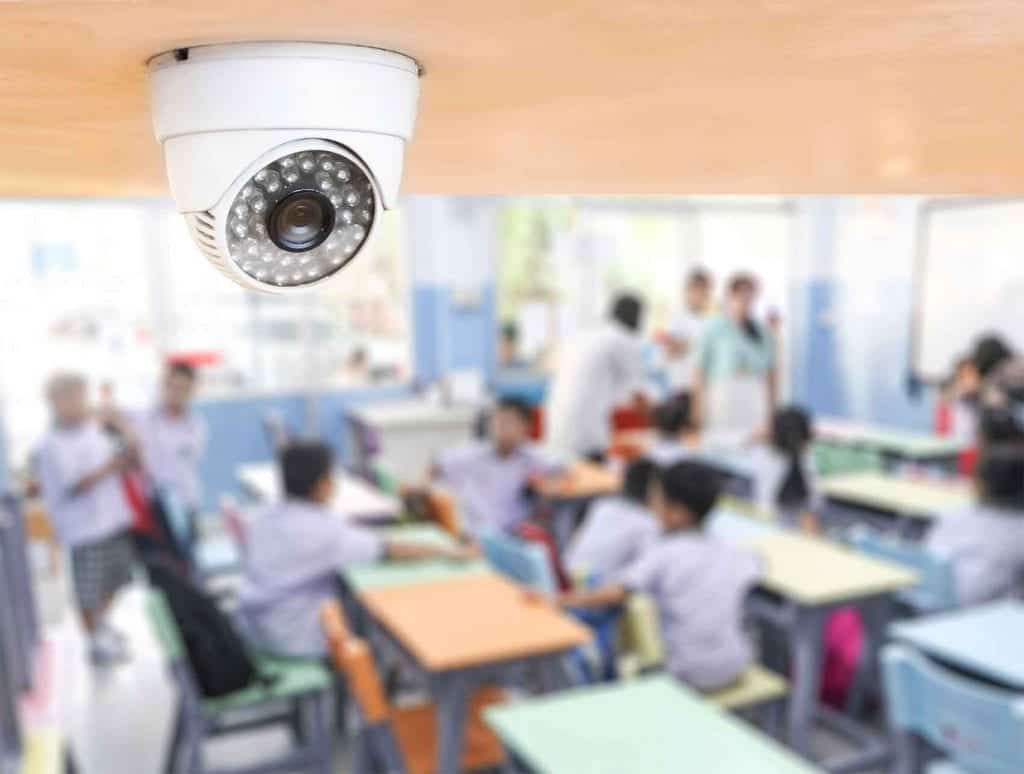
Are CCTV Cameras Needed in a School?
Not everywhere, and not in every school. Cameras are a tool. They help with some problems and do nothing for others. Putting up cameras where they are not needed costs money, adds legal duties, and can make people feel watched.
CCTV can help a school with:
- Stopping people getting in without permission, and logging who comes in
- Putting off bullying and fights in playgrounds and corridors
- Protecting car parks, bike stores and storage areas from break-ins
- Investigating incidents on school grounds
CCTV is only part of the answer to each of these. Stopping unwanted visitors, for example, also needs access control on the doors and gates.
Start with four questions for each area of the site:
- What or who are we protecting, and from what?
- Who else has a stake? For example, parents, pupils, staff and the local authority.
- How likely is the problem to happen?
- What would success look like? Stopping theft, or being able to identify an intruder?
Each of the problems above has the same shape: a specific threat, to specific people or things, in a specific place, sometimes only at specific times. The answers to the four questions show where cameras will help and where something else would work better. The Department for Education’s school and college security guidance (updated July 2026, for schools in England) has templates and checklists for this.
Where CCTV should and should not go
There is no official list of places where cameras are banned. Each camera has to pass the same test: is it justified, proportionate and necessary for that place?
Places where cameras usually pass the test:
- Main entrances, gates and reception
- Car parks and the site perimeter
- Corridors, stairwells and outside areas at busy times
- Areas where valuable equipment is kept
Places where cameras rarely pass the test:
- Classrooms. Most schools judge that problems in a lesson are unlikely to happen without a teacher seeing them. Some experts argue that classrooms for non-verbal children, who are at higher risk of abuse, are an exception.
- Toilets and changing rooms. These are the most private places in a school. In 2018, Summerhill School in Kingswinford removed cameras from its toilets after working with the ICO.
Can parents see CCTV footage of their child?
Sometimes. The right to see personal data belongs to the child, not the parent. The ICO’s guidance on education information says a parent can make the request for their child if the child is too young to act for themselves, or if the child agrees.
In Scotland, children aged 12 or over are presumed old enough to act for themselves. In England, Wales and Northern Ireland, it depends on the child’s understanding.
The school must reply within one calendar month, and the request is normally free. Other pupils in the footage may need to be blurred before it is handed over, or the parent may be offered a viewing instead of a copy.

A school’s legal duties when using CCTV
A school using CCTV takes on these duties.
Register and pay the fee
The old duty to “notify” the ICO ended in 2018. Today a school that records identifiable people must register with the ICO and pay the data protection fee each year, unless it is exempt. CCTV does not add a separate fee if the school already pays.
Assess the risk first
A data protection impact assessment (DPIA) is recommended before installing or extending CCTV. The ICO requires one where the processing is likely to be high risk.
Tell everyone
Put up clear signs in every area that is recorded. Say who runs the system and how to contact them. Many schools also remind parents, pupils and staff about the CCTV policy at the start of each school year, and again whenever something changes.
Everyone recorded should know why the cameras are there, what their rights are, and who to contact with a question or complaint. Recording people without telling them is allowed only in exceptional cases, such as a specific investigation into suspected crime, and only for a limited time.
Keep a CCTV policy
The policy should say why each camera is there, who can view footage, how it is stored and how long it is kept. The school is the data controller, and the policy should name the person responsible day to day.
Use footage only for its stated purpose
Cameras put up to stop vandalism cannot then be used to check attendance, for example. This applies every day, not just when the system is set up. The person responsible for the system should make sure staff who view footage know what it can and cannot be used for.
Do not keep footage too long
There is no fixed period. Many schools keep footage for about 30 days. If footage is part of an investigation, keep it until the investigation ends.
Answer requests for footage
Anyone filmed can ask for a copy. The request is normally free, and you must respond within one calendar month. A fee is allowed only if a request is clearly unfounded or excessive, or for extra copies (ICO guidance on subject access). Other people in the footage may need to be blurred first.
The police and other public bodies can also ask for footage of a set time and place, for example after a break-in. You need to be able to find the right cameras and times quickly and export the footage in a usable form. Modern recorders make this easier, but someone on staff has to know how to do it.
Keep footage secure
CCTV is only acceptable if footage is seen for proper reasons, by the right people. Protecting it is one of the school’s most important duties. Data breaches do happen, even though schools are rarely targeted, and the school is legally responsible.
Good protection starts when the system is designed:
- Choose equipment from makers with a good security record, and keep its software up to date
- Keep the recorder in a locked room, behind access control where possible
- Limit viewing to named staff, each with their own login
- Set out a process for viewing, copying and deleting footage, and keep a log
Once the system is running, the person responsible should check every so often that the process is followed and that footage is safe.
What to put in a school CCTV policy
A clear policy answers the questions parents, staff and the ICO are likely to ask:
- Why the school uses CCTV, and what each camera is for
- Where the cameras are, and where there are none
- Who is responsible for the system day to day
- Who can view footage, and when
- How long footage is kept, and when it is deleted
- How to ask for a copy of footage, and how long it takes
- How footage is shared with the police
- How to raise a concern or make a complaint
- When the policy will next be reviewed
Benefits and drawbacks of CCTV in schools
Every security measure is a trade-off, and CCTV is no exception. When cameras look like the answer to a problem, ask what the other side of the coin is, and whether it is worth it.
The main benefits for a school are:
- Putting off vandalism, theft and break-ins, especially out of hours and in the holidays
- Supporting safeguarding at entrances, gates and outside areas
- Giving a clear record when something goes wrong, so incidents can be dealt with fairly
- Providing evidence the police can use after a crime
- Reassuring parents and staff that the site is watched
The main drawbacks are:
- The cost of cameras, cabling, recording and installation, then maintenance each year
- The legal duties above, which take staff time
- The risk that pupils and staff feel watched, if cameras are badly placed
- Footage that nobody checks, which protects no one
The sections below look at three of these trade-offs in more detail.
Preventing crime and misbehaviour vs. extra responsibilities
Cameras can put off crime and bad behaviour. How well this works depends a lot on the school and how the cameras are used. In return, the school takes on the duties above. It also has to be ready to watch, record and act on what the cameras show. A camera nobody checks protects no one.
Security and Peace of Mind vs. Privacy
Cameras in a car park or at the gate help people feel safe. Cameras that seem to be everywhere have the opposite effect: people feel watched instead of protected. Fewer, well-placed cameras with a clear reason usually work better than many cameras with no plan.
Visitor logs vs. data volume
Cameras linked to access control can keep a record of everyone who enters a building. Number plate recognition (ANPR) can log every vehicle at the gate. Some systems add facial recognition, but that uses biometric data, which needs a strong legal reason and is very hard to justify for pupils.
The more cameras and features you add, the more footage you have to store, protect and search when someone asks for it. A smaller system that covers the right places is easier to run and easier to defend.
Planning a school CCTV system
A good school system is planned around safeguarding, not just the perimeter. In practice that means:
- A survey of the whole site, with the head, the business manager and the safeguarding lead
- Cameras placed to cover entrances, routes and outside areas, and kept out of private spaces
- Viewing limited to named senior staff and site staff
- Work planned around the timetable, exams and term dates, often in the holidays
- Links to other school systems, such as access control on gates and doors, and visitor sign-in
- A phased plan, so an older system can be replaced in stages as budgets allow
Older analogue systems can often be upgraded to IP cameras in stages. That spreads the cost and keeps the school covered throughout.
How we install CCTV in a working school
School work has to fit around the timetable, safeguarding rules and the people on site.
At L’Ecole des Petits in Fulham we replaced an end-of-life analogue system with an IP NVR system covering 9 camera views. We did it in a five-day summer window, with no disruption to term. Read the L’Ecole des Petits case study.
We also delivered the ICT infrastructure at Royal Russell Junior School in Croydon.
Conclusions and Recommendations
CCTV is common in UK schools. Used in a way that is technically sound, justified, proportionate and necessary, it can help protect pupils and staff.
Deciding where cameras belong, and how to run them, is not a simple yes-or-no choice. There are social and ethical questions to weigh as well as technical ones. Start with the security need, involve the people affected, write a clear policy, and keep the system to what the school really needs.
Our guide to CCTV laws in the UK covers the wider legal picture.

Frequently Asked Questions – CCTV in Schools
Q. Are schools allowed to use CCTV?
Yes, where it is justified, proportionate and necessary. The school must follow UK GDPR and the Data Protection Act 2018, pay the ICO data protection fee, put up signs and keep a CCTV policy.
Q. Do schools have to register CCTV with the ICO?
A school that records identifiable people on CCTV must register with the ICO and pay the annual data protection fee, unless it is exempt. There is no separate CCTV fee if it already pays. The old duty to notify the ICO about CCTV ended in 2018.
Q. Can I see CCTV footage of my child at school?
Often, yes. The right belongs to the child, but a parent can ask for the child if the child is too young to act for themselves or agrees. The school must reply within one calendar month, and may blur other pupils.
Q. Is CCTV allowed inside the classroom?
No law bans it, though it is rarely justified. Most schools judge it too intrusive for normal classrooms. Some experts argue it can be proportionate in classrooms for non-verbal children.
Q. Are there places in a school where CCTV should not be used?
There is no fixed list, but toilets and changing rooms are the most private places in a school, and cameras there are very hard to justify. In 2018 one school removed toilet cameras after working with the ICO.
Q. How long should a school keep CCTV footage?
There is no fixed period. Many schools keep footage for about 30 days, and longer only when it is needed for an investigation.


Written by
Wayne founded ACCL in 1997 and has led more than 28 years of project delivery, helping organisations design, install and modernise the network infrastructure behind reliable connectivity, office moves and refurbishments. His experience spans copper cabling, fibre backbones, data centre infrastructure, Wi-Fi, CCTV and access control. About ACCL