Data Cabling Installation
For a modern office building, cabling, this vast array of copper wires that powers and drives the globalised, high-paced business world of today, is as important as steel frames and elevators. Virtually every aspect of modern business communication relies on high-volume and/or real-time data traffic, from conferencing to VoIP and from respectable email to Slack, and high-speed networks have dramatically transformed existing businesses, from banking to entertainment, and opened up entirely new fields, like high-frequency trading. Data cabling installation companies were forced to adhere to new, stricter standards.
Real estate companies were also forced to adapt quickly, and while the industry as a whole was relatively successful in accommodating their clients’ first steps toward the digital world in the late ‘90s and early ‘00s, many real estate developers have been caught by surprise by the rapid shift towards digital operation.
In just a little more than ten years, cloud computing, mass adoption of mobile devices, BYOD (Bring Your Own Device) policies, and the Internet of Things have radically changed the networking demands of modern companies. In turn, this has radically changed the way office networks are planned, installed, maintained and expanded.

Why does this approach fail for modern business networks? There are three major issues with it:
- The techniques and standards used for data cabling are quite different from those used for electrical wiring.
- The complexity, diversity and size of modern networks make it hard for data cabling that was deployed as an afterthought to electrical wiring to support your business’s operations.
- A network that can barely support current devices is unlikely to be able to cope with tomorrow’s demands – a vital threat to the well-being of any business.
Even though cabling is the least expensive component of a modern network, it is the physical foundation on which the network rests, and – like any foundation – it needs to be not only solid but also adequate for the type of load that it supports.
Regulatory problems. Wiring regulations and standards, both for electrical and data wiring, are extremely complex and cover a great surface of issues, ranging from fire safety to electrical and optical signal integrity. Some of these issues, like avoiding tripping hazards, are common, but most of them are not. Some installation requirements and techniques are similar, but many (such as patching and terminating) differ significantly.
Treating one category of cabling as auxiliary to another often involves sacrificing some compliance. Since failure to adhere to electrical codes is usually more visible (and potentially more dangerous), many companies choose to sacrifice compliance with telecom and networking standards.
With some exceptions (mainly concerning H&S and private data protection), failure to adhere to data cabling standards will rarely result in legal trouble, but it does ultimately boil down to simply having a lower-quality network, with chronic performance issues that are difficult to troubleshoot. Link issues, insufficient or inadequate plugs, signal quality problems are common symptoms of improper data cabling installation, and their occurrence is difficult to predict.
Unfortunately, these problems surface only as the office equipment is being deployed and starts being regularly used. Some of them creep in slowly – badly installed cable sections, for instance, can work for a while before rapidly deteriorating.
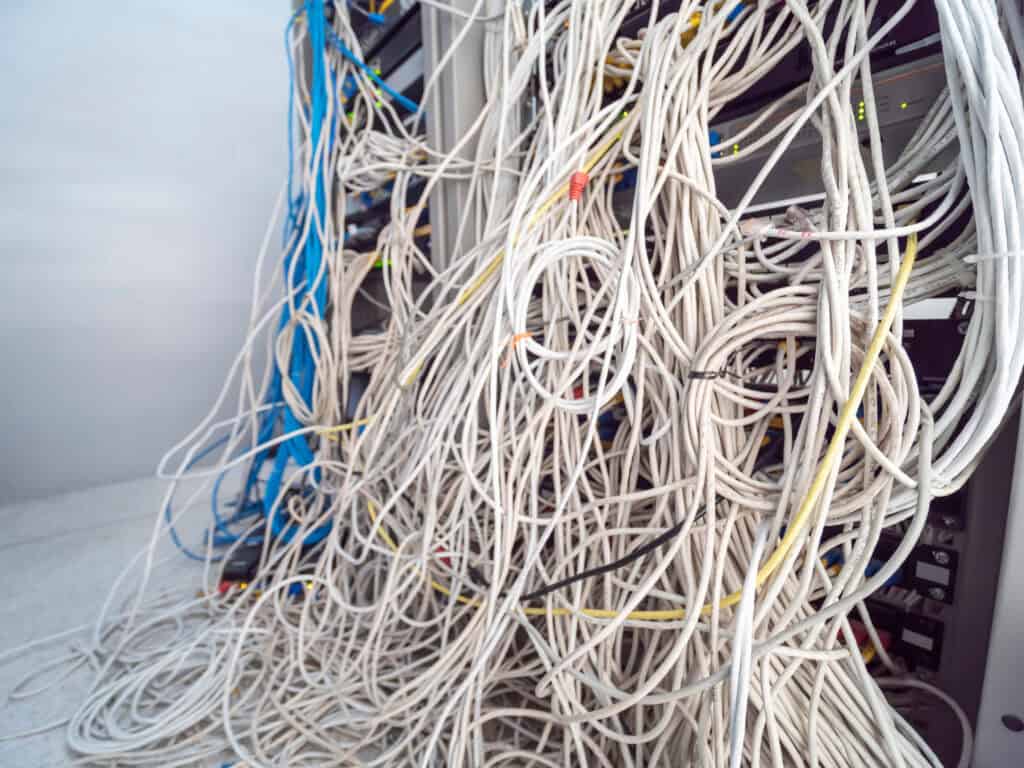
Not only are these problems difficult to troubleshoot, but they are often dealt with using ad-hoc patches: you install additional switches in offices that have too few sockets, run cables to the sockets at the other end of the room to avoid the bad ones and so on. This results in mounting costs, trailing cables, and lengthy, costly troubleshooting.
There is simply no way to do that without an RF survey and without prior knowledge of how your network is laid out. A best-guess approach, with access points installed wherever it was most convenient, or wherever the electrical cabling company happened to run data cables, results in poor Wi-Fi performance and non-uniform, inconvenient coverage. In our experience, this is the leading cause of the proverbial inconvenient Wi-Fi network, which barely has any signal and grinds to a halt in office areas, where everyone needs it, but runs great in the cafeteria and around the reception.
Modern office networks also require high speeds more uniformly than a few years ago: high-definition content for training videos, business calls and even the occasional YouTube video place higher strain throughout the network, not only on the backbone and server-room network.
Coping with these demands requires significant planning effort, because high-speed network performance depends on a great deal of parameters, such as cable type, length and even bend radius or proximity to electrical cables. More importantly, however, it requires specific installation techniques and, more often than not, special installation equipment.
Most electrical wiring companies only aim to offer basic data network installation services. Their target customers are businesses with basic networking demands that are unlikely to grow, such as those outlined in the beginning of this section. It makes sense for these companies to treat data cabling as an inconsequential expense that needs to be minimized, but this does not work for everyone.
Expansion and Emerging Technologies. These are, perhaps, the two most difficult points to deal with. Data cabling installation needs to reconcile two difficult demands: minimizing expenses, which requires using as little cabling and equipment as possible and the best price/capabilities ratio for current use, and dealing with long-term network growth, which requires spare equipment and cabling, and the most future-proof set of capabilities.
Meeting medium- and long-term expansion demands require, at a minimum, an awareness regarding these demands. Consequently, it can only be achieved if the long-term requirements of your business, your development plans for that particular office and the way they fit in your long-term vision are taken into account as early as the planning stage of the network.
A network that slows down or requires a great deal of maintenance as it grows may seem like little more than a nuisance, but with so much of modern business being conducted digitally, a lack of scalability in your company network directly translates to a lack of business scalability.
The risk is even greater when you begin to factor in emergent technologies. A recent Gartner report, for instance, recognises that IoT “presents a myriad of opportunities for leading organisations to address their business issues”, and the same organisation predicts that business users will account for more than 7 billion deployments of IoT devices.
Furthermore, modern networks are not comprised solely of office computers. They integrate security and access control systems, building management endpoints and many other types of devices.
This radical growth in device numbers and diversity will be one of the leading causes of business data network growth, and you need to be prepared for it.

What does this mean for data cabling installation?
First of all, it means that it is no longer done haphazardly or based on a “generic” customer profile – instead, it implements a specific network design that has been tailored to your business’ current and long-term needs. Second, it means that data cabling installation is often conducted separately from other building and/or furnishing efforts unless it has been integrated in the building plan. And, finally, that it needs to be carried out using specific installation techniques, respecting legal and industry requirements that are specific to data cabling.
A custom-made data cabling design and installation procedure does have higher upfront costs and it can take longer to implement. The cost of installing a generic data cabling (usually when the office building is erected) is supported by the developer and while it is obviously “hidden” in the lease cost, it is typically much lower than that involved in a customised data network.
The counter-argument that is most often invoked when discussing upfront cost is that the higher upfront price is compensated by better performance and lower maintenance costs, as well as more easily amortised by the network’s increased performance. This is a valid point, but it hides an even more important point.
A well-designed data network cabling is not only a solid foundation today but also keeps your business open to the possibilities of tomorrow. There is, for instance, a great deal of untapped potential in smart buildings, such as significantly reduced energy bills and more efficient and flexible security systems.
In other words, being able to rely on high-quality data cabling is a competitive asset for your company, ensuring not only a solid foundation for day-to-day operations right now but also a competitive edge tomorrow.
At ACCL, we don’t cut corners when it comes to your long-term benefits. Every London data cabling installation project we undertake happens after discussing your long-term plans. We need to understand how you plan to grow so we can make sure your network can easily grow along with you.
For all your data cabling installation needs in London Get in touch with us for your FREE, no obligations consultation. We’d be happy to discuss the best solution for your London company cabling in terms of both cost and performance.
Related topics: Office cabling installation

Frequently Asked Questions (FAQs)
Q. What does a data cabling installation involve?
It starts with a survey of the building and how your business works, then a design for outlets, routes and cabinets. Engineers install containment, cables, patch panels and outlets, then test, certify, label and document every link. Planning the layout around your real needs, not a generic profile, is what makes the network last.
Q. What is included in a commercial network installation?
Usually structured copper cabling to desks and devices, fibre between comms rooms or floors, cabinets with patch panels and cable management, and outlets for Wi-Fi access points, CCTV and phones. Switches and Wi-Fi equipment can be added on top. The scope should list each outlet, the cable category and the test standard.
Q. What is a data point installation?
A data point is a network outlet, usually a faceplate with one or two sockets, wired back to a patch panel in the comms cabinet. Installing one means running the cable, terminating both ends, then testing and labelling it. Data points are planned for desks, printers, screens, access points and any device needing a reliable wired connection.
Q. How do I choose a data cabling installer for a commercial property?
Look for a specialist with commercial experience, its own trained engineers, recognised accreditations and certification testing on every link. Ask for a site survey, a written scope, references from similar buildings and full documentation at handover. ACCL’s own engineers carry out its surveys and installations, rather than subcontracted installers.
Q. Which standards apply to commercial cable installation?
In the UK the main ones are BS EN 50173 for the cabling system, BS EN 50174 for installation practice, ISO/IEC 11801, and BS 6701 for telecoms installation. BSI and ISO publish the documents. Your installer should name the standard in the scope and certify every link against it, so you can check the work at handover.
Q. What is the best data cabling for a commercial building?
For most commercial buildings, Cat6A copper to desks and devices, with fibre backbones between floors or comms rooms. Cat6A supports 10 Gigabit speeds and Power over Ethernet for access points and cameras, so it suits a long building life. Smaller or shorter-term sites may use Cat6 where speeds and budget allow.
Q. How is a structured cabling project carried out?
It normally runs in five steps: survey, design, installation, testing and handover. The survey and design fix outlet positions, routes and cabinet locations. Installation follows the agreed standard, then every link is certified. Handover includes labels, cable schedules, test results and as-built drawings, so later changes are straightforward.
See it in practice: our seven-floor London network infrastructure upgrade for The Writer and our 37-branch infrastructure programme for Chestertons and Chase Buchanan both started with the same business-needs-first planning approach. For commercial installations specifically, see our Commercial Data Cabling service.


Written by
Wayne founded ACCL in 1997 and has led more than 28 years of project delivery, helping organisations design, install and modernise the network infrastructure behind reliable connectivity, office moves and refurbishments. His experience spans copper cabling, fibre backbones, data centre infrastructure, Wi-Fi, CCTV and access control. About ACCL