Choosing night vision CCTV cameras
Night vision technology can be traced back to the early 20th century and was primarily developed for military purposes. In the 1930s, German scientists developed the first infrared or IR night vision devices, known as Starlight Scopes. These devices used an image intensifier tube to amplify available light in low-light conditions. Since then, technology has rapidly evolved, and today, night vision technology is used across various applications and can be found in homes and businesses across the globe, particularly for security and surveillance purposes.
Millions of people throughout the UK rely on CCTV cameras for the protection of their property, their families, or for the protection of their businesses. Night vision CCTV cameras are the only ones that can guarantee a certain level of protection 24/7, which makes them very popular.
But, as in any other field of the tech industry, competition leads not only to better performance in general but also to a proliferation of features and technologies. Night vision CCTV cameras are no exception.
Manufacturers, service providers and security consultants can, upon command, produce a seemingly never-ending litany of technical parameters and standards that sound very important and relevant. But – just as with anything else, from cars to computers – not all of them are equally important to everyone.
So how do you choose the best night vision camera? What parameters of a night vision security camera are relevant for your property, or for your business?
If you just pick the camera that ticks all the boxes, has the most features, lists the best parameters and so on, you’ll just end up buying the most expensive one. And, since many parameters are, in fact, correlated, you may end up buying a camera that gets everything right except for one thing that you really need. A one-size-fits-all is just as bad when choosing security devices as when choosing a suit.
Indoor vs. Outdoor Night-Time Cameras
Let’s start with the most basic differentiating feature: where a camera is installed.
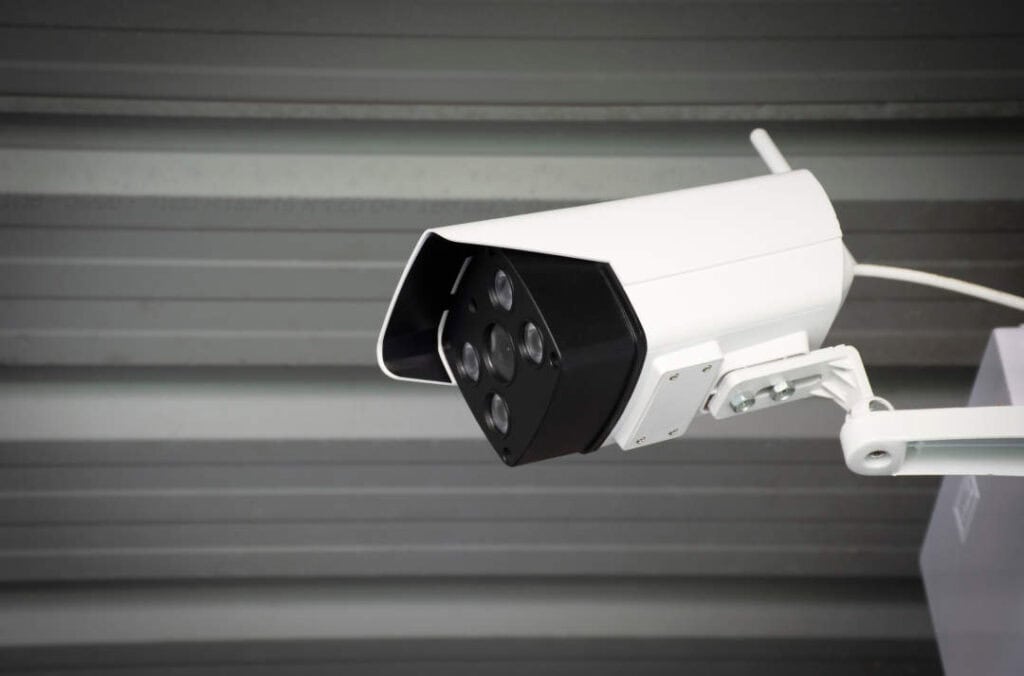
There is no fundamental difference in terms of imaging technology or inner workings between an outdoor CCTV camera and an indoor one. However, outdoor night vision cameras have their housings and electronics designed to withstand a harsher environment than those designed for indoor use.
All CCTV cameras have specific ratings, known as the Ingress Protection (IP) rating, which indicates the level of protection against dust and water, these are particularly more relevant for outdoor cameras. Ratings are given two-digit names, such as IP65 or IP66. The first rates protection against dust and solid objects, and the second one refers to protection against liquids. The minimum rating you should consider for standard outdoor surveillance is an IP rating of IP66, but a higher rating of IP67 or 68 – is recommended for more challenging conditions. Ratings such as these or above are generally reserved for cameras that can be immersed in liquids, which you are very unlikely to need.
Why would you want to install a camera in an outdoor environment? The most obvious reason, of course, is that you have to monitor a large outdoor area, such as a parking area or a large garden. But even small areas, like a porch or a small garden, often need to be monitored using outdoor CCTV cameras. That’s because, for reasons that we will discuss shortly, you cannot aim night vision CCTV cameras at windows.
Night Vision CCTV Installation Constraints
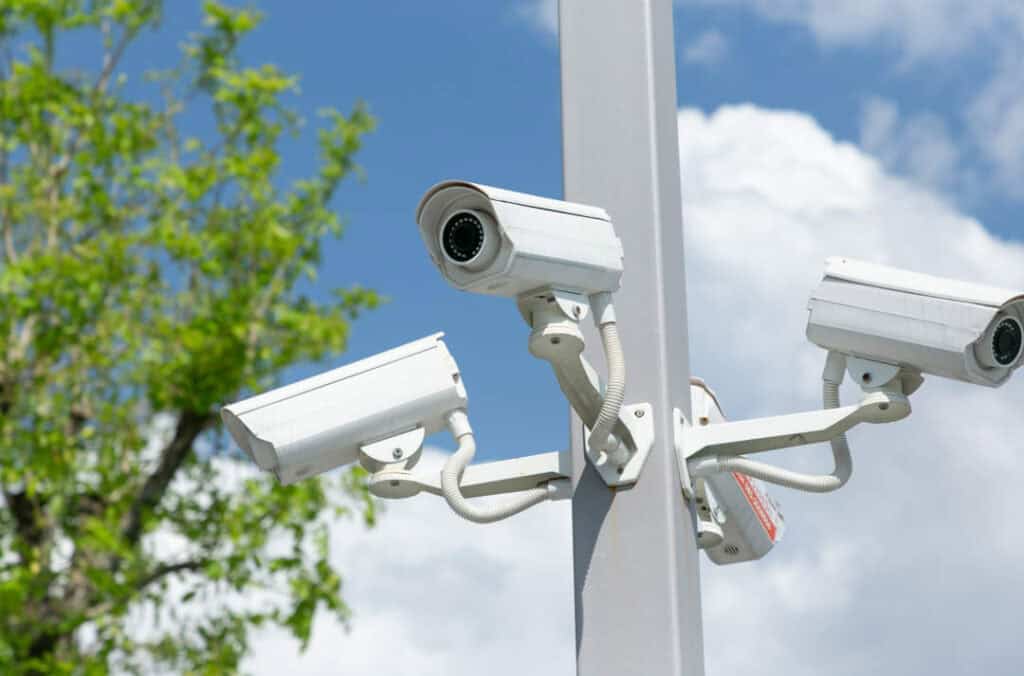
Like all CCTV cameras, security cameras with night vision features are subject to a few installation constraints. They cannot see around corners, for example, and they can only cover a limited area.
CCTV cameras for 24/7 or night-time surveillance pose some additional, specific installation constraints. We’ve already hinted at some of them: they have to be installed away from windows, the maximum distance depends on optical as well as illumination parameters, and some cameras, such as colour night vision cameras, may require a specific level of ambient light.
However, many other additional constraints come into play. For example, CCTV cameras installed in areas with heavy vehicle traffic have to cope with quick variations in lighting conditions caused by the headlights of passing cars. Some cameras are designed to be particularly good at coping with these situations and have a high dynamic range, but even these have to be installed so that they cannot be easily “blinded” by simply parking a car in front of them.
At ACCL, we have spent the past two decades finding and installing the best night-vision security cameras in London and the surrounding areas. Our partners – Assa Abloy, Avaya, Honeywell, and Paxton help us make sure that our clients always have access to the best night vision CCTV cameras in the UK.
Night Vision vs. Day/Night CCTV Cameras
True day/night CCTV cameras have imaging sensors that can register both IR and visible light. During the day, the IR component of the spectrum is eliminated using an IR cut filter.
This enables them to compensate not only for low ambient light conditions, but also for variable ambient light. In other words, their firmware can adjust the image so that you get a clear picture both during the day and during the night.
Day/night CCTV cameras are particularly useful for monitoring locations that need 24/7 surveillance, since they can provide clear footage throughout the day.
Camera Range
A variety of optical parameters – at the most basic level, the focal length – determine the range that a CCTV camera can cover. The rule of thumb about it is simple: a higher focal length means a camera can focus on objects that are further away, but it also means it covers a narrower area. In other words, it can cover a greater distance, but its field of vision is narrower.
Many night vision security cameras will explicitly list the maximum distance they can cover. This is particularly relevant for day/night CCTV cameras, because the maximum distance that they can cover is not determined only by their optical parameters, but also by the intensity of their IR light and the sensitivity of their imaging sensors.
Image Quality
When talking about a CCTV camera’s image quality, we tend to lump together several factors, such as resolution and sharpness. Some of these parameters are correlated, but in surprising ways!
Image resolution is the most obvious aspect. The higher a camera’s resolution is, the more details it can capture in a well-focused image.
1080p (2 MP) cameras are generally sufficient for most scenarios, but higher-resolution cameras – 4K or higher – may be useful if you need detailed surveillance over a wider area or at high distances. However, it’s worth remembering that a higher image resolution also results in higher storage requirements!
How sharp an image is depends not only on the camera’s resolution, though, The minimum and maximum distance at which a camera can provide a sharp, focused image depends on a variety of optical parameters, in addition to the sheer quality of the lens(es) and imaging sensors. Consequently, you want to pay attention to optical specifications as well as resolution.
Power and Connectivity
We are so used to seeing CCTV cameras everywhere that we tend to think of them as these tiny electronic islands of sorts, but in truth, they aren’t. Like all electronic devices, they need electrical power to work – and they need to transmit their pictures somehow. In fact, this is their giveaway. If you were wondering how to spot night vision cameras, this is it. Look for the power source.
Most CCTV cameras today are IP cameras, which means they plug into a computer network. Unsurprisingly, then, night vision CCTV cameras come in wired or wireless options.
Wired connections are cheap and high-capacity, which means that they are particularly useful for cameras that need to send high-resolution pictures or cameras that need to be very cheap. On the other hand, you have to run a data cable to them. That means extra maintenance and installation effort, not to mention a cable that an intruder can simply cut if it’s exposed.
Wireless CCTV cameras do away with the data cable, which makes them convenient to install and operate. However, their range is limited to the access point’s range. Nowadays, Wifi networks are fast enough that you can stream high-resolution images over a quality connection – which is to say that wireless cameras are not a good option in areas where you can’t rely on a strong Wi-Fi signal.
Many Wi-Fi cameras are battery-powered, so that they are, indeed, truly cable-free. At the other end of the spectrum, many wired cameras use a technology called Power over Ethernet (PoE), which enables them to use the same cable for both power and data connectivity.
Connectivity doesn’t directly influence a CCTV camera’s night vision capabilities, but it does influence deployment options, which can be relevant for nigh-time surveillance. For example, wireless cameras are easier to deploy along fences than their wired counterparts.
Night Vision CCTV Installation Constraints
Like all CCTV cameras, security cameras with night vision features are subject to a few installation constraints. They cannot see around corners, for example, and they can only cover a limited area.
CCTV cameras designed for 24/7 or night-time surveillance pose additional specific installation constraints. We’ve already hinted at some of them: they have to be installed away from windows, the maximum distance depends on optical and illumination parameters, and some cameras, such as colour night vision cameras, may require a specific level of ambient light.
However, many other additional constraints come into play. For example, CCTV cameras installed in areas with heavy vehicle traffic have to cope with quick variations in lighting conditions caused by the headlights of passing cars. Some cameras are designed to be particularly good at coping with these situations and have a high dynamic range, but even these have to be installed so that they cannot be easily “blinded” by simply parking a car in front of them.


Frequently Asked Questions – Night Vision CCTV
Q. What is the difference between night vision and day/night CCTV cameras?
True day/night cameras have sensors that register both infrared and visible light and use an IR cut filter to switch between them, giving a clear picture in both daylight and darkness. A basic night vision camera uses IR LEDs and produces a black-and-white image at night.
Q. Why can’t night vision cameras be pointed at windows?
Infrared night vision cameras illuminate the area with their own IR LEDs. If aimed at a window, that light reflects straight back into the lens, so the camera only records the reflection of its own lights rather than anything useful.
Q. What resolution do I need for night vision CCTV?
1080p (2MP) is usually sufficient for most scenarios. Higher resolutions such as 4K can help for detailed surveillance over a wider area or at longer distances, but they also increase storage requirements.
Q. Should I choose a wired or wireless night vision camera?
Wired connections are cheaper and higher-capacity, which suits cameras sending high-resolution footage, but a data cable has to be run to each one. The right choice depends on the site and how the footage will be used.
Q. Do night vision cameras need special installation planning?
Yes. They need to be positioned away from windows and within their effective range, and locations with heavy vehicle traffic or variable lighting need cameras rated to cope with rapid brightness changes.
Q. Can one camera cover both day and night reliably?
A true day/night camera can, since it automatically adjusts between visible light and infrared modes. A basic night-vision-only camera is optimised for low light and may perform less well in bright daylight.
Q. Can night vision CCTV cameras record in colour?
Standard infrared cameras switch to black and white in the dark. Colour night vision cameras use very sensitive sensors, wide apertures and often a small white light to keep colour in low light, which helps identify clothing and vehicles. They need some light to work with, so they suit lit car parks and entrances better than completely dark areas.
Q. How far can a night vision CCTV camera see?
It depends on the camera’s infrared illuminators, and each model’s rated infrared range is on its datasheet. That rating is how far the camera can detect something, not how far it can identify a face or read a number plate. Where identification matters, position cameras well inside their rated range and test the picture at night before handover.


Written by
Wayne founded ACCL in 1997 and has led more than 28 years of project delivery, helping organisations design, install and modernise the network infrastructure behind reliable connectivity, office moves and refurbishments. His experience spans copper cabling, fibre backbones, data centre infrastructure, Wi-Fi, CCTV and access control. About ACCL