CCTV cameras are among the most deployed security instruments in the UK. We are used to seeing them virtually everywhere by now, which is unsurprising, given their efficiency and convenience. However, their use in certain situations has not been without controversy. The installation of CCTV in schools, in particular, is a very sensitive topic.
While the effectiveness and importance of CCTV cameras in terms of security are well-known, security is not a field that deals in absolute terms. When examining a particular technology, the question you should be asking is not “Is this technology effective?”.
What you should be asking instead, about any technology, including CCTVs, are questions like:
– Do we need to deploy this technology?
– Do the benefits of installing CCTV cameras outweigh their drawbacks?
– Are the drawbacks acceptable in the first place?
– What legal responsibilities do we have, and how can we effectively handle them?
These are some of the questions that we hope we’ll be able to help you answer today.
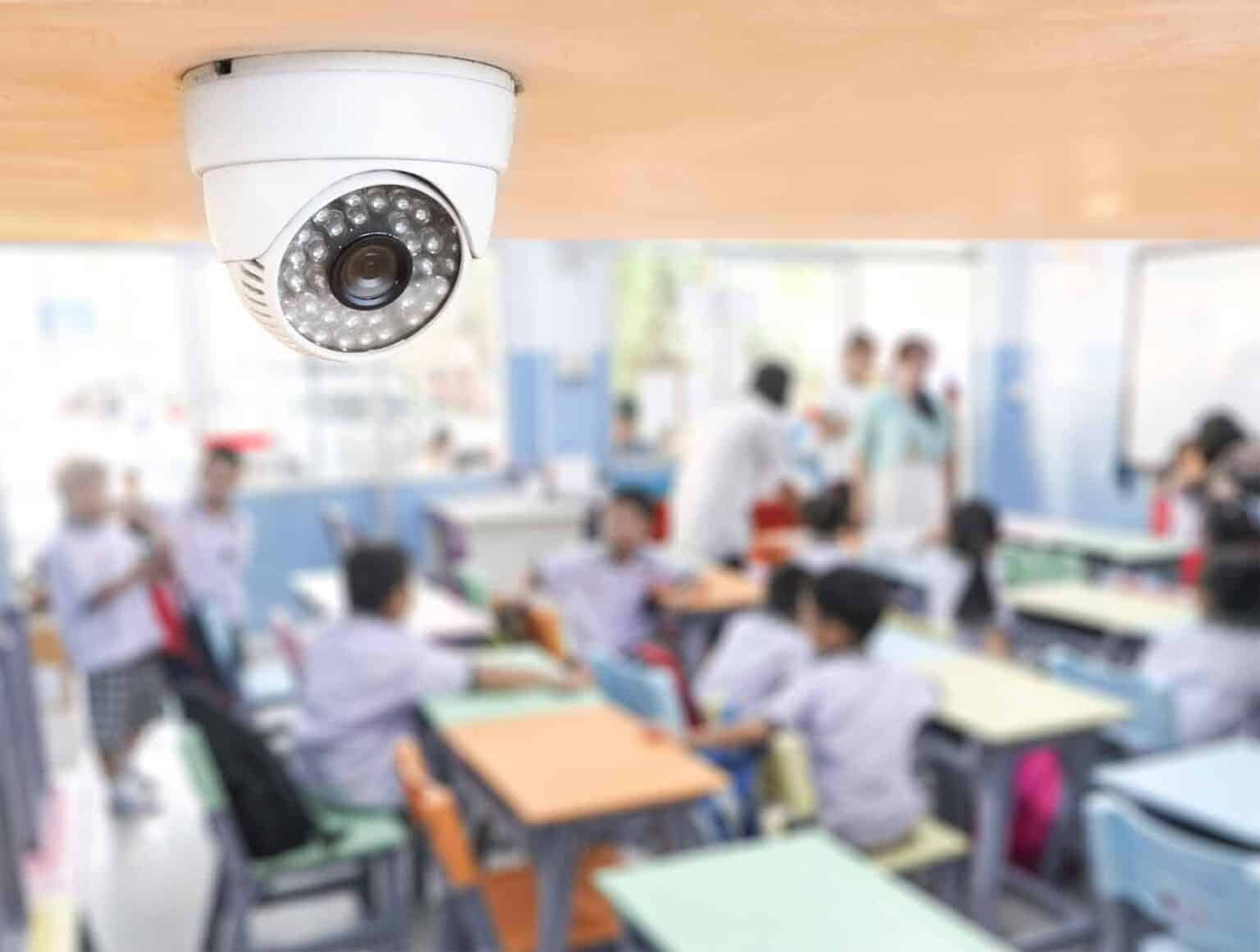
Are CCTV Cameras Needed in a School?
The question of whether you need CCTV cameras or not is very slippery. It’s easy to frame it in the wrong context.
Are CCTV cameras needed everywhere in a school? And in any school? Definitely not. But when placed in some areas, they can be part of an effective solution to some problems.
Some of the things that CCTV cameras in your school can help you with are:
- Preventing unauthorised entry and providing video logs of authorised entry in an area or a building
- Preventing bullying or abuse on playgrounds or in classrooms
- Monitoring various rooms or sections in order to deter or enable you to respond to unwanted or illegal behaviour
- Monitoring storage areas or parking areas to prevent or enable you to respond to break-in attempts
- Aiding internal or external investigations regarding incidents that have occurred on a school’s premises
Note that all these scenarios are defined by a number of specific elements: specific threats that need to be addressed, against specific persons, objects or activities, in a specific area and sometimes only during specific intervals.
It’s equally important to note that CCTV cameras are a component of the solution to every one of these problems. Unauthorised entry, for example, is prevented not only through CCTV cameras but also by installing access control systems.
What’s the process behind the decision to use a CCTV camera in these scenarios? By and large, it involves answering four important questions about each area of a site – every room, every annexe, every section of the school ground:
- What persons, objects or activities do you need to protect, and against what threats?
- What other parties need to have their requirements taken into account and be kept informed? In other words, who are your stakeholders? Parents? Students? Local authorities?
- How likely is it that the threats you have identified will materialise?
- What is a successful outcome of your measures against each threat? Preventing theft or damage? Identifying intruders?
Why go through this examination? Because it will enable you to determine the most effective solution for every scenario and every area under your responsibility. Read the Department for Education guide on Site Security.
Pros and Cons of CCTV Cameras in Schools
Evaluating which security measures are the most effective is always a matter of compromise. CCTV cameras are no exception. When you see CCTV cameras as an effective solution to a particular problem, always ask yourself what’s on the flipside of the coin. Are the drawbacks worth it?
What are the pros and cons of using CCTV cameras in schools?
Security and Peace of Mind vs. Privacy
CCTV cameras have an important psychological effect on those they protect. The presence of CCTV cameras in a parking area, for example, gives you a little peace of mind. You know your car is probably safe – one less thing to worry about.
However, CCTV cameras are surveillance tools. Cameras that are obviously unnecessary or eerily omnipresent do not give you a sense of safety, they give you the sense that you are being watched.
This matter is complicated by the fact that there is no list of places where you can or can’t place cameras.
For example, CCTVs in school toilets are not explicitly forbidden, but the ICO has asked some schools to remove them.
So, how do you balance these requirements? The guideline is that the use of CCTVs must be:
- Justified: You should be able to explain why you need to keep an area under surveillance, rather than survey it just because you can
- Proportionate: the threats that you want to counter should be serious enough and likely enough to justify the use of a surveillance system in countering them
- Necessary: surveillance systems should effectively address the threat that you want to counter, rather than being needlessly deployed along with the “real” solutions
These qualities should be estimated on a case-by-case basis. For example, there is no explicit rule that says you can or can’t use CCTV cameras in a classroom.
Their use for security reasons – mainly to deter abuse and assault – is infrequent, because most schools deem it unlikely that such events will happen in a classroom without intervention.
There is one exception: schools with disabled children, particularly non-verbal children, who are at a significantly higher risk of being abused than other children. Consequently, some experts recommend the use of CCTV cameras in classrooms with non-verbal children.
In such cases, the use of CCTV cameras may be viewed as proportionate, even though it’s generally a disproportionately intrusive security measure.
Visitor and Personnel Tracking vs. Data Volume
CCTV cameras can be an effective way to obtain video logs of everyone who accesses certain rooms or areas. CCTV cameras can be integrated with access control systems or augmented by advanced features such as facial recognition or automatic number plate recognition (ANPR), which give your logs an entirely new dimension.
However, the flipside to CCTV cameras is that you are responsible for protecting and, occasionally, sorting through the data that they provide. For example, visitors and students can ask you for the footage which they are shown, and you are obliged to provide it.
Similarly, under some conditions, the police or other authorities can ask for CCTV footage taken during a specific time interval. It’s up to you to ensure that you can sift through the video recordings from all your cameras and come up with the data that was requested.
Legal Obligations: What You Need to Do, and How
The legal framework that governs CCTV use in UK schools is complex but manageable. We cannot cover it all here, but we can at least give you the important landmarks.
By and large, your responsibilities fall into six areas:
- Ensuring that CCTV use is justified
- Notifying and providing required data to authorities, and consulting all stakeholders
- Ensuring that everyone is aware that they are being surveyed
- Ensuring that CCTV cameras are used correctly
- Retrieving data when requested
- Protecting data against unauthorised access
Ensuring that CCTVs are used only when justified is the first and foremost responsibility of any educational institution. There are plenty of cases where deploying CCTVs is justified and beneficial, but CCTV cameras are not useful or appropriate everywhere.
This is best achieved by conducting an appropriate analysis early in the design stage. This is the same recommendation that the Home Office makes in its CCTV operations manual.
Notifying authorities and consulting stakeholders. UK schools have a statutory requirement to notify the ICO when CCTV cameras are installed, or when the way they are used is changed.
They also need to keep the ICO informed about the purpose of the CCTVs and about the identity of the data controller – the employee (or employees) – responsible for the CCTV systems.
School management is also required to consult stakeholders where appropriate. Ultimately, the school is responsible for determining security requirements as much as it is responsible for fulfilling them.
Ensuring awareness. Once the decision has been made, the school is responsible for ensuring that everyone who may become the subject of surveillance knows about it.
It is also the school’s responsibility to ensure that everyone involved knows the purpose of this surveillance, that they know their rights, and that they know who to contact for questions or complaints. Only under exceptional circumstances, and only temporarily, are you allowed to monitor people without their knowledge.
How do schools comply with this requirement?
The most straightforward solution is to display clear and visible signs in every monitored area.
In addition, many schools explicitly notify stakeholders about their surveillance policy, about their rights, and about the relevant persons of contact. This is done periodically, for example at the beginning of every school year, but can also be done whenever something relevant changes.
Ensuring that CCTV cameras and their footage are used correctly is essential to legal compliance. This means that schools are responsible for ensuring that CCTV systems are used for their stated purposes. For example, CCTV cameras that have been installed to prevent vandalism cannot be used to monitor school attendance.
This requirement permeates everyday activity, but it’s up to the data controller to ensure that cameras are properly used.
It’s also the school’s responsibility to ensure that CCTV footage is not retained for an unreasonable period of time.
There is no strict requirement. 30 days is a good rule of thumb, but you can keep footage for less than that if you think it is sufficient, or longer if you think it is needed. In some cases, it can become necessary; for example, if a fragment of footage is used in an investigation, you need to retain it until the investigation is concluded, even if it takes longer than your usual retention time.
Retrieving data when requested is also your responsibility. You will have to provide video footage under two circumstances.
First, anyone can ask you to provide recordings in which they are present. You can charge a processing fee for it, but you have to provide the recordings if they exist.
Second, public authorities, such as the police can ask for footage under certain conditions.
Modern CCTV systems come with software that simplifies this task, but you are required to ensure that you have the staff who can use it.
Protecting data against unauthorised access is a critical component of CCTV use. Its importance cannot be overstated. CCTV technology is a viable security instrument and an acceptable method of surveillance only if data is accessed for strictly legitimate purposes, and only by authorised personnel.
Data breaches happen, even if schools are somewhat low-profile targets, and schools are legally responsible for them.
How do you ensure adequate protection of your data?
The foundations of adequate data protection are laid when the system is designed. Common measures taken at this time include using equipment from manufacturers with a good security track record, ensuring that physical access to storage media is restricted using adequate access control systems, and devising procedures for viewing, transferring, and erasing data.
Once the system has been deployed, it is up to you to ensure that these procedures are followed, and that data is indeed adequately protected. In practice, this is up to the data controller, who needs to periodically review procedures and assess compliance.
Conclusions and Recommendations
CCTV cameras are commonly used in UK schools. When used in a manner that is technically sound, justified, proportionate and necessary, CCTV cameras can be of great aid in protecting pupils and staff.
Determining when the use of cameras is appropriate and how to effectively deploy them is not a straightforward process. There’s no simple yes-or-no decision tree, and there are plenty of social and ethical issues to consider, in addition to technical ones.
But don’t worry – you’re not alone in this. We’ve been installing CCTV cameras in London schools for the past 20 years, so we know the ins and outs of everything related to surveillance. Check out our CCTV installation services and let’s talk!
Related topics: Installing CCTV, CCTV employee rights, Questions to ask about CCTV, Vision of Control: A Case Study on School CCTV.

Frequently Asked Questions – CCTV in Schools
Q. Do schools need CCTV cameras everywhere?
No. CCTV isn’t needed in every school or in every area of a school – it works best when placed in specific locations to address specific problems, such as unauthorised entry, playground incidents or storage-area break-ins.
Q. Are there places in a school where CCTV shouldn’t be used?
There’s no fixed list, but some placements are more sensitive than others. For example, the ICO has asked some schools to remove CCTV from toilets, even though it isn’t explicitly forbidden.
Q. What test should a school apply before installing CCTV?
Use should be justified (a clear reason for surveilling that specific area), proportionate (the threat is serious and likely enough to warrant it) and necessary, rather than installed simply because it is possible.
Q. Does installing CCTV in a school create legal responsibilities?
Yes. Schools become responsible for protecting the recorded data, being clear about who and what is being monitored, and being able to actually monitor and respond to what the cameras capture.
Q. Can CCTV cameras make pupils and staff feel less safe rather than more?
Yes, if they are seen as unnecessary or overly intrusive. Cameras that feel omnipresent can create a sense of being watched rather than genuine peace of mind.
Q. Does CCTV actually prevent misbehaviour in schools?
The presence of cameras can act as a deterrent, but how effective this is depends heavily on the social and operational context in which the cameras are used, not just their presence.


Written by
Wayne founded ACCL in 1997 and has led more than 28 years of project delivery, helping organisations design, install and modernise the network infrastructure behind reliable connectivity, office moves and refurbishments. His experience spans copper cabling, fibre backbones, data centre infrastructure, Wi-Fi, CCTV and access control. About ACCL