Why network resilience starts with the cabling infrastructure
Every digital initiative in a modern workplace from hybrid meetings and cloud apps to IP security, access control and smart‑building systems rests on the same foundation: your physical infrastructure. Resilience isn’t just a property of switches and firewalls; it begins with how and where your cables run, how they’re powered, protected, labelled and tested, and whether the physical design eliminates single points of failure.
When cabling is treated as an afterthought, the symptoms show up everywhere else: jittery video, intermittent device drops, unexplained outages in certain zones, and “ghost” faults that bounce between teams. Conversely, when the cable infrastructure is engineered for redundancy, diversity, maintainability and observability, uptime stops being a negotiation and becomes a design outcome.
This article focuses on practical cabling strategies from diverse risers and redundant fibres to PoE power envelopes and cabinet discipline that keep UK enterprises running, floor after floor, year after year.

Design outcomes for uptime: the four pillars
- Redundancy: Duplicate what must not fail links, pathways, termination points so the service survives a single fault.
- Diversity: Ensure redundant elements do not share a common mode of failure (e.g., separate risers, opposite facades, different ducts or ceilings).
- Maintainability: Make the plant easy to work on under time pressure clear labelling, slack management, service loops, and safe cabinet layouts.
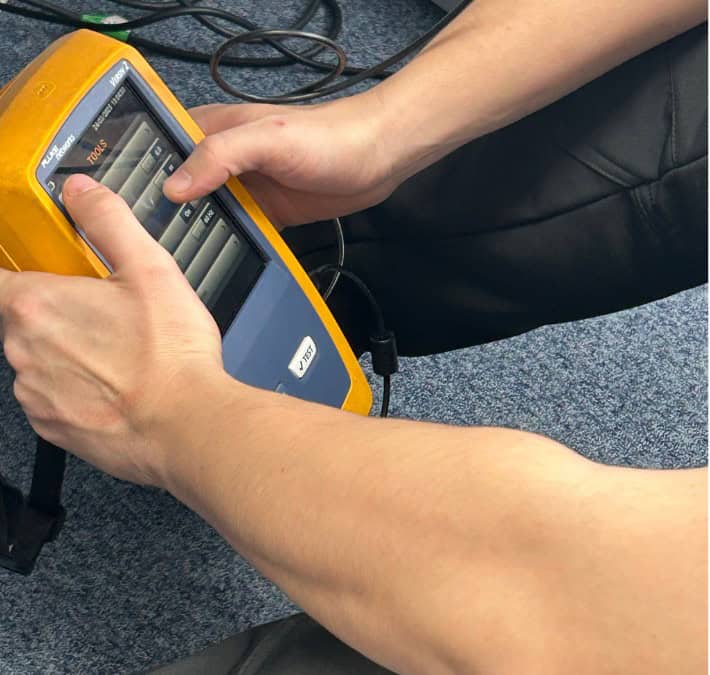
- Observability: Certify and baseline the entire plant, and expose live telemetry (errors, PoE draw, temperature) so small issues never become big outages.
Topology choices at the cabling layer
Star‑of‑stars with resilient distribution
In multi‑storey offices, a star‑of‑stars topology remains the gold standard: horizontal runs from outlet/ceiling device to a local telecoms room (TR), and resilient fibre uplinks from each TR to distribution/core. For resilience:
- Dual fibres per TR to diverse core switches (or separate switch stacks) with physically diverse riser routes.
- Spare strands pulled and capped in each route; the cheapest time to add redundancy is when the ceiling is open.
- Local patching discipline: Keep horizontal copper to 90 m channel budgets with tidy, labelled patching; avoid chaining small switches above ceilings.
Rings vs. dual‑star
Campus and venue designers often consider fibre rings. Rings offer alternate paths but can introduce operational complexity. A dual‑star (each edge/TR dual‑homed up separate paths) is simpler to reason about and keeps failure domains small. If a ring is used, treat splicing closures and handholes with the same diversity rules as entry ducts—two faults shouldn’t share a pit.
Consolidation points and MPTL
For ceiling devices (APs, cameras, sensors) in open offices, MPTL (Modular Plug Terminated Link) cabling avoids excess connections and improves reliability. Where consolidation points are required (e.g., churn‑heavy zones), keep them accessible, labelled and documented; they are a legitimate tool, not a shortcut, when planned correctly.
Physical pathway strategy: diversity you can see
Think of pathways as roads. Resilience isn’t just having two lanes—it’s having two roads that don’t flood together or close for the same works. Practical steps:
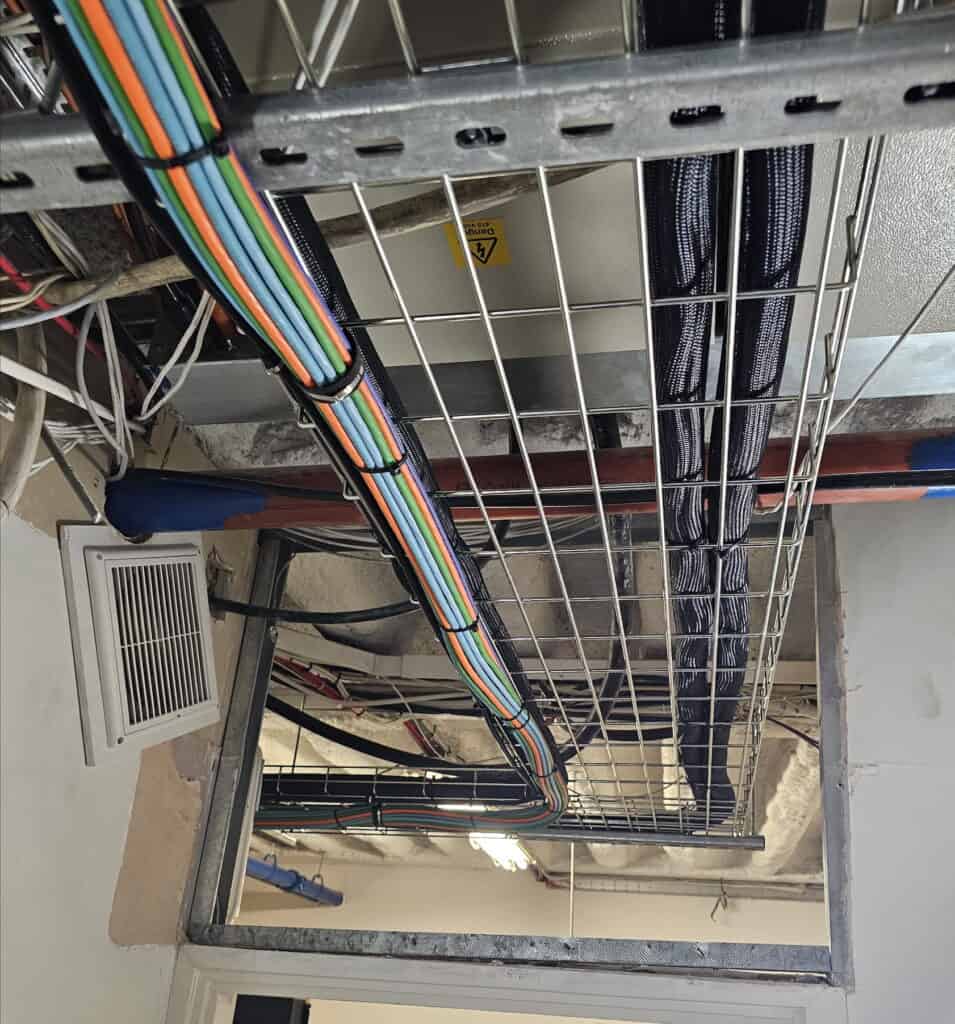
- Two risers per block, serving opposite halves of the floorplate. If that’s not possible, use diverse tray runs that split early and re‑converge only at the destination.
- Diverse building entries for carrier services and campus fibre: opposite facades where possible, different ducts, and separated internal routes to the comms room.
- Separation from power to BS/EN best practice: route planning avoids paralleling high‑load cables for long distances; cross power at 90° where required.
- Environmental resilience: Avoid routes with known condensation or water‑ingress risks; use external‑grade/SWA where exposure demands it; seal penetrations meticulously for fire and smoke.
- Slack and service loops: Include manageable slack at panels and device ends; it’s cheap insurance for maintenance and future moves.
A useful mental check: “If a contractor cut or flooded any one tray, any one duct, or any one riser, would critical services stay up?” If not, add diversity.
Horizontal copper for resilience: Cat6a as your baseline
Horizontal runs underpin everyday uptime. In 2025 the enterprise default remains Cat6a for good reasons:
- Headroom for multi‑gig: Even if you start at 1 GbE, Cat6a comfortably supports 2.5/5/10 GbE to 100 m—critical as Wi‑Fi 6E/7 and UC workloads rise.
- Better PoE thermals: Larger conductors and better alien‑crosstalk characteristics reduce temperature rise in powered bundles, keeping devices stable.
- EMI margin: In mixed‑use buildings with lifts, HVAC, LED drivers or plant, Cat6a’s noise immunity protects your service envelope.
Shielding and earthing: Use U/UTP or F/UTP based on environment; if you specify shielded cabling, ensure consistent earthing and bonding end‑to‑end. Poorly terminated shield is worse than none.
Spares and serviceability: Pull a small percentage of spare runs to critical zones (e.g., boardrooms), and keep them documented and dressed. Well‑placed spares turn a 90‑minute outage into a 9‑minute fix.
Power strategy & PoE resilience (because no power = no network)
Resilience is as much an electrical question as a data question:
- Right‑sized PoE budgets: New tri‑radio APs, PTZ cameras and analytics sensors can draw 25–45 W. Dimension switch per‑port classes (PoE+/UPoE/802.3bt) and total budget per stack with worst‑case power in mind.
- Thermal management: High‑power PoE generates heat. Control bundle sizes, avoid hot pathways, ventilate cabinets, and prefer Cat6a for its thermal behaviour.
- Endpoint vs. midspan: Where switch PoE is constrained, midspan injectors can be strategic for a handful of high‑draw devices. Treat them as first‑class citizens (documented, powered, monitored), not ad‑hoc fixes.
- UPS and segmentation: Back up core and access closets with appropriately sized UPS so a brief mains disturbance doesn’t ripple into hours of device re‑associations. Segment critical PoE loads across separate switches/PDUs so a single failure doesn’t darken every camera on a floor.
- LLDP policies: Use LLDP‑MED/PoE negotiation consistently; it prevents under-powering that manifests only at busy hours.
Cabinets, rooms and patching: day‑two resilience
You don’t operate the network in Visio; you operate it in the cabinet. Design for safety and speed:
- Space and airflow: Respect RU planning, keep hot equipment in appropriate racks, and avoid blocking airflow with cabling.
- Aisle hygiene: Safe working clearances and properly secured ladders/trays reduce accidental dislodgement during maintenance.
- Patching discipline: Short patch cords, colour‑coded where helpful, all labelled to schema (floor‑cabinet‑RU‑panel‑port). A patch field you can read at 2am beats tribal knowledge every time.
- Document as‑builts: Update drawings after any change. If documentation lags reality, resilience is already eroding.
If your cabinets are already a chokepoint, a focused tidy can change operational outcomes overnight—fewer mistakes, faster MACs, safer access. (Ask about our cabinet remediation if this resonates.)
Campus and outside‑cable considerations
Between buildings, environmental and civil factors dominate:
- Diverse duct routes: Two physically separate ducts between buildings, with independent entry points and distinct internal path to the comms rooms.
- External‑grade choices: Use armoured (SWA) or micro‑duct solutions where excavation risk exists; ensure correct water‑blocking and UV‑resistant jackets.
- Lightning and earthing: Treat outside cabling with appropriate protection; earth metallic elements and follow best practice for surge suppression at building entry.
- Wireless as a resilience layer: In some estates, a licensed or carefully engineered point‑to‑point wireless link provides an alternate path if a fibre is damaged during civil works. For design considerations and use cases, see point‑to‑point wireless links.
Migration without drama: phased upgrades that keep the lights on
- Zone by zone: Start with the highest business impact (boardrooms, collaboration hubs, trading or operations floors). Maintain parallel service during cutover windows.
- Fit‑out alignment: The cheapest time to add diverse pathways and spares is during planned fit‑outs—when ceilings are open and trades are on site.
- Bridging tactics: Where a full re‑pull isn’t feasible immediately, prioritise new home‑runs for critical devices and TR uplinks, with clear end‑dates for temporary media converters or injectors.
- Rollback plans: Every change window gets an explicit rollback. Resilience isn’t just early planning—it’s discipline under pressure.
Budgeting for resilience: where the ROI hides
Resilient cabling isn’t an aesthetic investment; it’s measurable risk reduction:
- Reduced incidents and MTTR: Clear pathways, documented routes and spares turn faults into fast fixes.
- Fewer business‑hour surprises: Better PoE thermals and diverse routes eliminate “random” device drops and accidental back‑hoe moments.
- Compliance and insurance: Documented fire‑stopping, earthing and load management reduce audit time and risk premia.
- Enablement: With a trusted plant, you can confidently deploy Wi‑Fi 6E/7, UC suites and IP security without constantly chasing “mystery” faults.
Real‑world reliability: trading floors, venues and beyond
Uptime is most visible where every second counts—trading floors, control rooms, broadcast or live venues. Designs that succeed in these environments share a pattern: diverse risers, dual‑homed TRs, disciplined patching, and spare optics staged on‑site. For an illustration of standards‑led delivery in a mission‑critical, time‑sensitive environment, see Transforming Sumitomo Corporation Europe Limited’s London trading floor.
Final thoughts & next steps
Cabling resilience is not an optional extra—it’s the precondition for everything you want your workplace to do, reliably, at scale. The best time to design it in is before you need it; the second‑best time is now.
If you want to baseline risk, uncover single points of failure and design a future‑proof path (without disrupting the day job), let’s start with evidence and a plan:
- Commission a structured audit and remediation roadmap: Cabling and network auditing services
- Align risers and spines with your core roadmap: Data centre solutions

FAQ – Building Resilient Networks
What makes cabling infrastructure “resilient” rather than just functional?
Resilient cabling infrastructure has diverse routes or dual paths for critical links, spare capacity for growth, clear labelling and documentation for fast fault-finding, and certified testing so faults are rare rather than routine.
Do I need redundant cabling paths for every part of the network?
No – redundancy is usually prioritised for business-critical links such as server room connections and core backbone runs, rather than every desk outlet, since full redundancy everywhere is rarely cost-effective.
How does poor cable labelling affect network uptime?
Poorly labelled or undocumented cabling significantly increases the time it takes to diagnose and fix a fault, since engineers have to trace connections manually rather than referring to accurate records – turning a five-minute fix into an hour-long outage.
Can an existing network be made more resilient without a full rewire?
Often yes – a network audit can identify single points of failure and documentation gaps, allowing targeted improvements such as adding a diverse route for one critical link, rather than rewiring the whole building.
How do I build cabling resilience?
Use redundant links over diverse physical pathways, certify everything, right‑size PoE and switch budgets, and maintain impeccable cabinet hygiene with live documentation.
What’s the best cable for resilient office networks?
In 2025, Cat6a is the enterprise baseline for horizontal runs; pair it with single‑mode fibre risers and campus links for long‑term headroom.
How many spares should we pull?
At least one spare fibre pair per route per TR and a small percentage of spare copper runs to critical zones. Spares are cheap during install and priceless during incidents.
Do we need wireless back‑up between buildings?
Sometimes. A well‑engineered point‑to‑point wireless path can provide interim resilience during civil works or where diverse ducts aren’t feasible.
See it in practice: our seven-floor London network infrastructure upgrade for The Writer was designed with exactly this kind of resilience and documentation in mind. See also our structured data cabling hub and our network auditing service.


Written by
Wayne founded ACCL in 1997 and has led more than 28 years of project delivery, helping organisations design, install and modernise the network infrastructure behind reliable connectivity, office moves and refurbishments. His experience spans copper cabling, fibre backbones, data centre infrastructure, Wi-Fi, CCTV and access control. About ACCL