Liberty International
Long-term network support across a shopping-centre portfolio.

Wireless Network Installation & Support London
Survey-led retail Wi-Fi across London, Surrey and Kent, built for PoS, handheld scanners and guest Wi-Fi.
Long-term network support across a shopping-centre portfolio.
Readings inside and around the unit set channels and power.
Noisy work in evening or overnight windows.
A dedicated PoS SSID and VLAN.
Recent retail work: Liberty International
Retail and shopping-centre Wi-Fi
ACCL surveys, designs and installs Wi-Fi for retail sites across London, Surrey and Kent. The finished network supports tills, scanners, stock activity, staff devices and guest access, with radio settings planned around neighbouring networks and each store’s trading needs.
Wireless design and governance for larger and multi-site organisations.
Explore corporate wireless →Predictive and physical surveys before any equipment is specified.
Explore Wi-Fi surveys →Access points, cabling, configuration, testing and handover.
Explore Wi-Fi installation →How the design changes for each sector.
Explore sector Wi-Fi →Recent projects
Shopping centres, a flagship store and multi-branch work.
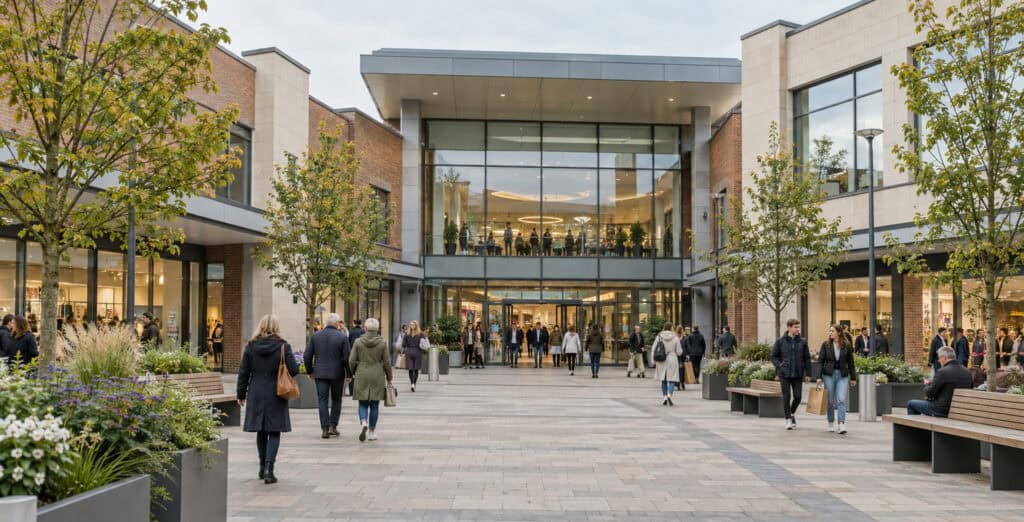
Support for a major UK retail portfolio, maintaining structured cabling, fibre, security and centre communications.
Illustrative image
Read the case study
Around 1,500 Cat6 outlets and resilient OM4 and OS2 fibre infrastructure for the London flagship store.
Read the case study
A 37-branch multi-site infrastructure programme across London.
Read the case study
One of the earliest deployments of ACCL’s Tenant Active System, still running the centre’s day-to-day communications.
Read the case studyWi-Fi installation guide
Retail wireless is designed around transactions and stock activity before guest convenience. ACCL records PoS terminals, scanners, click-and-collect points, staff devices, signage and CCTV so the network serves the workflows that keep the store trading.
Multi-tenant centres need a plan for neighbouring access points and landlord systems. Radio measurements are taken inside and around the unit, then channel and power settings are fixed for the store’s cells rather than left to a generic automatic plan.
Liberty International used ACCL for long-term network support across a major shopping-centre portfolio. That named experience sits alongside 60+ Google reviews.
Dense shelving, fridges, mirrors and firebreaks can leave stock aisles or back-of-house rooms without reliable signal. A floor plan alone does not show that attenuation, so test access points and on-site readings are used to check proposed positions.
Mall interference creates overlapping SSIDs and co-channel traffic from neighbouring units. Channels, widths and transmit power must be set from the measured environment if cells are to remain usable at peak footfall.
Wired constraints often appear as wireless faults. Access points connected through 100 Mb/s runs, under-powered PoE switches or hot untidy cabinets cannot deliver their expected throughput.
A shared VLAN also allows Guest, PoS, Staff and IoT traffic to compete and creates unnecessary access between services. Separate SSIDs, VLANs and policy controls keep those groups apart.
Discovery maps the tills, stock workflow, collection desk, handheld devices, signage, cameras and building services. Trading hours, visual-merchandising changes and landlord access rules are recorded before installation windows are agreed.
The RF survey measures walls, chillers and mirrors, observes neighbour SSIDs and validates positions with test APs. New stores can be modelled from drawings and confirmed during installation.
Access point counts and antenna types are selected for shop floors, corridors, deep stock aisles and entrances. Channel width and power are tuned, minimum data rates are set, and 802.11k/v plus 802.11r where supported can improve roaming for compatible devices. ACCL implements 802.1X for corporate devices and QoS for voice or handheld workflows where those controls are included in the design.
The wired assessment checks risers, containment, cabinets, PoE and uplinks. Cabling remediation can be phased outside trading hours where the existing foundation is not suitable.
Flagship and large-format stores need capacity for peak footfall, launches and dense mixes of customer and operational devices. Their controller profiles can include settings for event days as well as normal trading.
High-street and convenience stores need compact designs that still reach tills and stockrooms. A repeatable controller configuration and naming scheme helps an internal team apply the same operating model across several branches.
Concessions and mall units require channel and power settings that coexist with landlord Wi-Fi and adjacent tenants. A store-in-store SSID plan can preserve separation where a concession operates inside a larger retailer.
Rollout templates can package controller configuration and naming conventions for later stores. Each new site still needs its physical layout and radio conditions checked before that template is applied.
The access point mix can include low-profile units for the shop floor, directional or higher-gain equipment for deep stock aisles, and weather-rated units at entrances or covered loading bays where required.
Clean, certified cabling provides the correct category run to each AP, with labelled outlets, ventilated cabinets and neatly dressed patching. A long inter-room or inter-floor uplink can use fibre where distance and capacity require it.
Guest access can use a branded captive portal or pass-through flow with rate limits that protect operational traffic. A dedicated PoS SSID and VLAN isolates payment terminals, while separate lanes cover scanners, tablets, printers, signage and sensors.
Monitoring settings can include health thresholds and rogue-device detection. Validation uses the store’s scanners and PoS equipment before handover, followed by heatmaps, as-built records, patching matrices, PoE budgets and controller backups.
The design is future-ready: it anticipates denser layouts, 6 GHz/tri-band APs and new digital touchpoints.
Work is phased by area so the store can continue trading. Noisy tasks are placed in evening or overnight windows, while agreed daytime work is screened and kept away from customers.
Store management coordinates sightlines, fixtures and reinstatement. Work areas are left without trailing leads, dust or unfinished routes before the next trading period.
Mall inductions, work permits and access protocols are included where required. New penetrations are sealed to maintain fire compartmentation, with LSZH cabling and compliant containment used when the site specification calls for them.
PoS segmentation can be aligned with guidance from the retailer’s QSA. Guest portal logging can be configured to minimise retained personal data while supporting the agreed analytics requirement.
Before you book
Yes. Disruptive work is scheduled outside trading hours, and quieter tasks are phased so each zone is tested and returned before opening.
No. The RF survey measures attenuation and workflow needs, allowing directional coverage to serve deep aisles without excessive overlap.
A portal should use caching and sensible rate limits for the expected demand. Its branding and access flow are agreed without allowing guest traffic to consume the PoS allocation.
The survey includes readings outside the unit. ACCL then sets channels and power for cells that account for the neighbouring networks measured during the visit.
Yes. The design can constrain 2.4 GHz cells for legacy scanners while prioritising 5 GHz, and 6 GHz where available, for compatible equipment.
The handover can include heatmaps, as-built records, patching matrices, PoE budgets, controller backups and a reusable naming and configuration template.
A retail Wi-Fi survey is free of charge and the itemised quote arrives before any work starts. A fixed-price proposal follows within 48 hours of receiving your retail floor plans. How long the work takes depends on the size of the site and trading hours and centre rules, so the phasing is agreed with store and centre managers at survey.

The team behind your Wi-Fi project
Wayne Connors founded ACCL in 1997 and has led our commercial cabling projects ever since. We’re a member of the London Chamber of Commerce and Industry.
Free Wi-Fi site survey
One of our own engineers surveys your site at no cost and with no obligation.
Excellent · 60+ Google reviews · Founded 1997 · £10m liability cover
Expert Insights

Why Wi-Fi black spots appear in offices and what causes them.
Read guide
The common mistakes behind poor business Wi-Fi, and how to avoid them.
Read guide
Why a site survey gives you the data to design Wi-Fi around how your building really behaves.
Read guideBrowse practical guidance, industry updates and planning tools for commercial network infrastructure projects.
Active Communication Company Ltd trades as ACCL, ACCL Data Cabling London and ACCL Data Cabling Kent · Commercial data cabling and network infrastructure specialists